The musings, cultural experiences, photos, trials, and tribulations of an American grad student studying medieval history, traveling as much as a grad student budget allows, and drinking lots of tea in the process.
Sunday, March 28, 2010
THE VIKINGS ARE COMING!
The Jorvik Viking Festival: A week-long celebration of everyone's favorite helmeted rape-and-pillage invaders. I find it somewhat ironic that what started out as a hostile invasion complete with raping, pillaging and lots and lots of destruction is now a major tourist draw. All that aside, if you're going to have a Viking festival in the UK, York's the place to do it. York was one of the areas that the Vikings settled into and there were a series of Viking kings of York for much of the 10th century. While these Scandinavian settlers (not just from Denmark- there were "Vikings" from all of the Scandinavian countries) seem to have adopted elements of native-British life, Christianity for example, they left behind a legacy of Scandinavian culture too.
York is filled with place names derived from Old Norse. A good example is any street ending in "-gate", Old Norse for "street": Spurriergate, Hungate, Micklegate, High Petergate, Low Petergate, etc. Same for the four "bars" or gates into the old city walls. Norse personal names also became common for descendents of both the Vikings and the English and this pattern persisted until the coming of the Normans brought "Christian" personal names (Thomas, John, Hugh, William, etc) into vogue. The Vikings also deserve credit for bringing currency to Yorkshire. Anglo-Saxons relied primarily on barter/trade, while the Vikings used gold bullion as a form of currency and later took the idea of minting coins from southern England and began minting their own coinage (which btw was both fancier and more elaborate than that produced in Wessex to the south.) So perhaps it is fitting that we celebrate the Vikings with loads of crafts people selling "Viking" wares. And don't worry, modern Vikings accept all major credit cards!
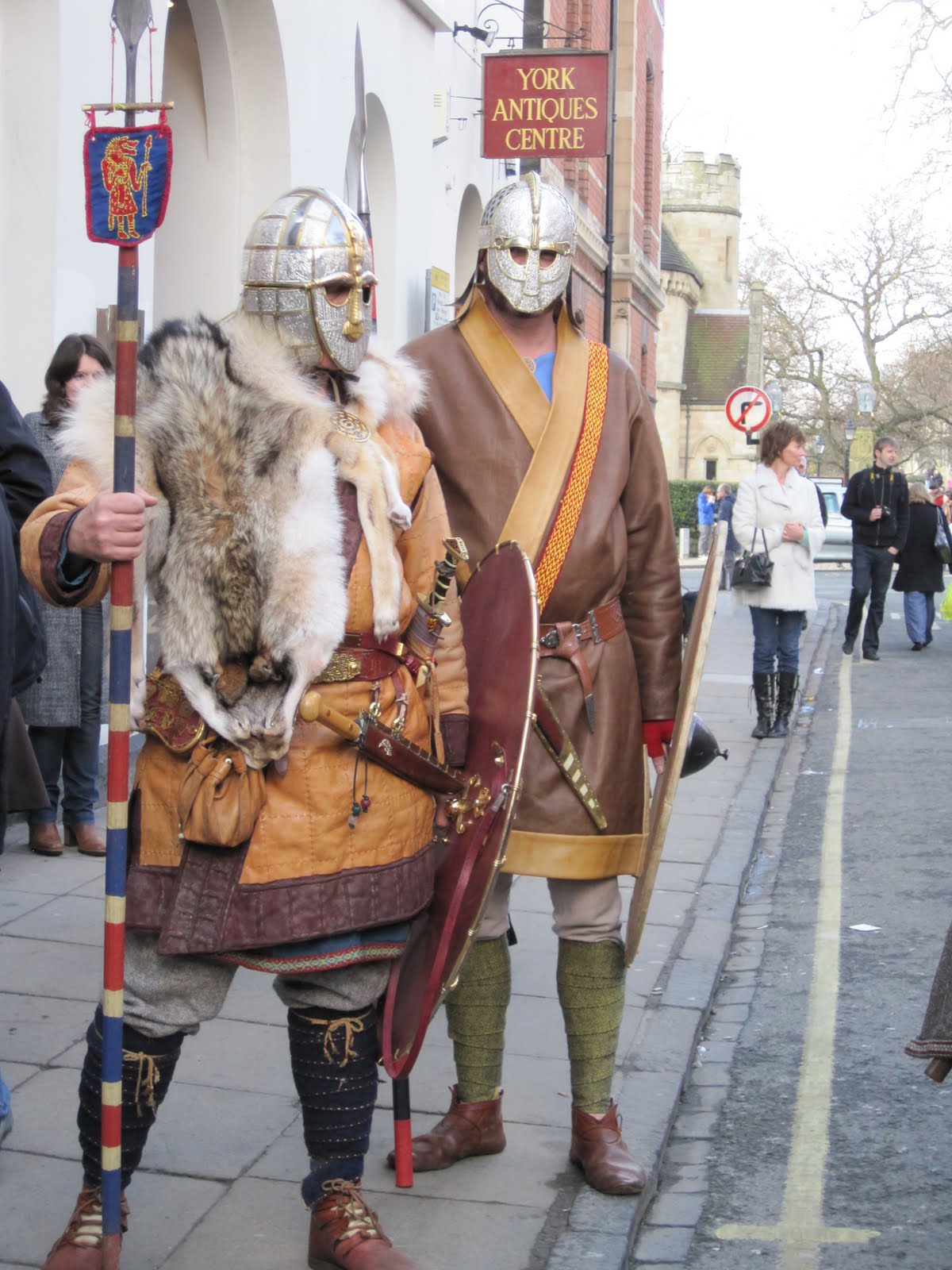
The annual Viking festival in February was perhaps especially celebratory this year because it marked the grand reopening of the Jorvik Viking Centre after a 4 month period of renovation. I haven't been to see what's changed, but it is supposed to be even better and more realistic than before, incorporating additional information from additional/newer archaeological reports from the Coppergate excavations. When you weren't standing in a reaaaaally long line to get into Jorvik, you could also enjoy a number of activities throughout the city. In Parliament Street, a tent hosted various demonstrations/shows geared towards the younger crowd, while in several locations merchants like the one pictured above sold Viking crafts, replica weapons and metal work, carved things, pins, fabrics... the list goes on. There were also walking tours and lectures and even a planetarium show about how the Vikings navigated by the stars.
York Minster joined the fun and hosted a Viking Music night, featuring this AMAZING harp player/singer, an all-female a capella group singing Scandinavian songs, a concert choir singing a mass (I'm not entirely sure how that fit in with the Viking theme, and I don't have the program to check which mass it was to see if there's a connection. Oh well.), and a reading of Egil's Saga, a later epic poem written (supposedly) about events taking place in York under Erik Bloodaxe, twice king of York and twice deposed. All of this was of course incorporated into the pageantry of the festival by having King Erik himself along with his royal entourage in the seats of honour.I feel like the Festival is probably more exciting if you're like 8-12, since most events are geared to a younger crowd. Maybe I'm just growing cynical in my old age, but I find craft projects and digging up pretend Viking artifacts slightly less exciting than some other events like...
The festival culminated in the Viking troops marching off for battle from the Museum Gardens, through the city of York and down to a lake outside of town for a ceremonial boat burning.
There they are, all lined up to go. There's actually three loooong lines of warriors- it was actually really impressive to see.
And there go the oft-forgot women & children, lugging all the supplies of course. The men have more important pillaging to do.
These two fine warriors were kind enough to stop for pictures with some kiddies.
Later that night to close the festival, they set a Viking boat on fire and set it adrift on the lake. I hear it was kinda neat and also involved standing around REALLY COLD for hours before they did so, but I wasn't there. I particularly enjoyed walking home and seeing all these dressed up Vikings going in and out of all the B&B's along my street and standing in line to checkout at the grocery store surrounded by Vikings. It was an interesting week :)
Monday, March 22, 2010
Durham
Ah, the city of Durham. My paleography class went to Durham on a field trip to check out Durham cathedral archives now based out of the Durham University Library, where we got to play with some fourteenth and fifteenth century documents. Above is the view walking from the train station into town. The big building is the cathedral and to its left is Durham University, housed in Durham Castle. That's right, if you go to Durham U you can have your dorm room in a castle. How cool would that be? Anyhoo, as you can tell, they are both up on a hill way above town (because in the British Isles, 75% of things worth seeing involve a hike up a hill, although Durham isn't nearly as bad as some- here's looking at you, Maeve's Cairn in Ireland)
Lalala, walking through Durham, only slightly confused by the directions my professor provided (we were meeting at the library). I took an early train so I could check out the cathedral.
And now I'm walking across the bridge admiring the castle. This was in late February, hence the snow on the ground, but it had been pretty warm recently. And silly me, the snow was mostly melted in York, so I worm my purple converses. Poor footwear decision for Durham, where it was all kinds of snowy and icey. Now, to get up to the hill where the cathedral and castle are, you have two options. 1) You can take a long and meandering route through town or 2) you can cut down a flight of steps past an Italian restaurant down to the river and then walk along a steep path up the hill. I didn't know about option #1, so up the hill I went. And nearly died.
Ok, ok, so I'm exaggerating. But not by much. If the snow and ice weren't making the path virtually a solid sheet of slipperiness and if I was wearing shoes with any kind of traction, it probably wouldn't have been as bad. But as it was, I basically slid up the hill by pulling on the railing. And while I didn't _actually_ slide backwards down the hill, it certainly felt like I could!
But once you make it up....
Ta da! Durham Cathedral: final resting place for St Cuthbert (who I became tight with over my term paper in the fall) and the Venerable Bede (who you may remember from my adventures to Bede's World). Now, the cathedral is awesome and awe-inspiring and any other adjectives you'd like to use with "awe," but I can't prove it. They don't let you take pictures inside. Jerks. So that's really all I can show you. I had lunch at the cathedral refectory on the recommendation of the professor (along with most of the class!). We were told it was inexpensive. That was a lie. It cost me over 6 pounds for a baked potato with cheese and a small hot chocolate. Even with crazy UK food prices, that shouldn't have been more than 4.50. (Blogger hates the pound sign. I'm not sure why.) Anyway, the cathedral was really cool and I recommend a visit. Architecturally and artistically, I think the York Minster is more impressive, but York doesn't have Cuthbert and Bede.
And then there's the castle:
Entrance to the castle is strictly by guided tours (which aren't exactly cheap either.) I didn't get a chance to go on one, but I hear it is pretty cool to go check out. So that was Durham. In my next post, the Vikings attack :)
Sunday, March 21, 2010
Rievaulx Abbey
So in case you didn't know, I'm mildly obsessed with monasteries. The ruined medieval kind, not the modern kind, although I'm sure they're cool too. Rievaulx is a particularly impressive ruin. The abbey was founded in the 12th century by a group of wanna be Cistercians from St Mary's Abbey in York (which was Benedictine). The Benedictines were once pretty much the end all and be all of monastic orders, but in the eleventh/twelfth centuries, an number of new orders arose either as a reformist sect or to fulfill specific niches in pastoral care. For example, the Franciscans and Dominicans started up as mendicant (i.e. owned no property and relied on the charity of others) preaching orders who were based in towns and served the religious needs of townsfolk. The Cistercians on the other hand withdrew off into the countryside to live in more austere conditions; they felt that the Benedictines had gone soft and were living too comfortable of a lifestyle, which went against the original view of monasticism. The group at Rievaulx was eventually accepted into the official Cistercian order and built a great big monastery with new additions and expansions added on over the years.
Originally, the abbey would have been built with no elaboration/decoration and with very minimal concessions to comfort. But over the years, the Cistercian monasteries throughout England relaxed their policies and more decorative features were introduced, along with renovations to increase the comfort of the brothers; deprivations of warm clothing and fires in every room worked in warm Mediterranean climates, but up in Yorkshire? No thank you!
Here's one end of the abbey church, and you can see just how big the thing was.
The relaxation of the policies against decoration can be seen in some fancy carving within the church, although I don't expect you can see much of it in this photo.
And here's the church from one end looking down towards the altar area.
Big big church. Not rivaling the cathedrals or York Minster perhaps, but as far as monastic churches go? Big.
Here you can get a closer look at the carving I mentioned earlier:
And here is a reassembled section of the cloister walk. The cloister garth was a square/rectangular open courtyard that likely had some gardens. Surrounding the garth was the cloister walk and the major buildings of the monastery- dorms, refectory, chapter house, etc- would be on the four sides of this compound. A covered walkway would lead around the garth. Originally this would have been open stonework like in the photo, but most monasteries converted these with windows to keep out the chill winds. I'm not sure if Rievaulx did or not; if they did, it didn't survive the Dissolution of the monasteries, at which point all of the glass and some stone from the abbey were carted back to York for reuse.
Behold! A medieval cafeteria!(Or in Brit-speak, a refectory)
Pretty cool huh? Rievaulx is notable for just how much of the monastery is still standing. A large contributing factor to its survival was the fact that in the 17th? 18th? century, a rich guy landscaped the ruins as a folly for his manor house, thus largely preventing further destruction of the abbey. Plus, the fact that it is pretty remote helped too. Because the Cistercians were seeking to withdraw from the world, they sought out sites away from towns and people, and their monasteries tended to survive the destruction following the Dissolution better than their counterparts in more populated areas. There's a whole slew of other photos in my facebook album if you're interested.
Originally, the abbey would have been built with no elaboration/decoration and with very minimal concessions to comfort. But over the years, the Cistercian monasteries throughout England relaxed their policies and more decorative features were introduced, along with renovations to increase the comfort of the brothers; deprivations of warm clothing and fires in every room worked in warm Mediterranean climates, but up in Yorkshire? No thank you!
Here's one end of the abbey church, and you can see just how big the thing was.
The relaxation of the policies against decoration can be seen in some fancy carving within the church, although I don't expect you can see much of it in this photo.
And here's the church from one end looking down towards the altar area.
Big big church. Not rivaling the cathedrals or York Minster perhaps, but as far as monastic churches go? Big.
Here you can get a closer look at the carving I mentioned earlier:
And here is a reassembled section of the cloister walk. The cloister garth was a square/rectangular open courtyard that likely had some gardens. Surrounding the garth was the cloister walk and the major buildings of the monastery- dorms, refectory, chapter house, etc- would be on the four sides of this compound. A covered walkway would lead around the garth. Originally this would have been open stonework like in the photo, but most monasteries converted these with windows to keep out the chill winds. I'm not sure if Rievaulx did or not; if they did, it didn't survive the Dissolution of the monasteries, at which point all of the glass and some stone from the abbey were carted back to York for reuse.
Behold! A medieval cafeteria!(Or in Brit-speak, a refectory)
Pretty cool huh? Rievaulx is notable for just how much of the monastery is still standing. A large contributing factor to its survival was the fact that in the 17th? 18th? century, a rich guy landscaped the ruins as a folly for his manor house, thus largely preventing further destruction of the abbey. Plus, the fact that it is pretty remote helped too. Because the Cistercians were seeking to withdraw from the world, they sought out sites away from towns and people, and their monasteries tended to survive the destruction following the Dissolution better than their counterparts in more populated areas. There's a whole slew of other photos in my facebook album if you're interested.
Monday, March 15, 2010
Scarborough Castle
Next up, Scarborough. Yes, that Scarborough from the "Scarborough Fair" song (which, btw actually originates as a folk ballad from at least as early as the mid 1600s.) The song itself refers to a fair held in Scarborough during the Middle Ages and on. Although the fair no longer occurs, the town does hold various events to mark the date when the fair was traditionally held in the summer. Nowadays, the town is known for its beaches (although it is pretty fair north, so I wouldn't want to swim there except MAYBE in the hottest part of summer) and for its wicked awesome castle.
The castle is built on a headland jutting out into the ocean way up above the town below.
So as you can probably tell, it is a great big sprawling mass of castle and I love it. I think Scarborough is far and away the most impressive castle I've been to, just on account of its size and position.
Following is mostly a photo spam because I don't really have a history lesson for you (I'm not super familiar with the history of Scarborough Castle.)
This is approaching the keep. The keep would have included a hall for the knights and visitors. The upper level was likely the lord's chambers, however later a separate building was constructed to house the chambers for the lord & his family. In Scarborough's case, "lord" was actually the king; the early phases of the castle were built by an aspiring nobleman during the Anarchy- between 1135 and 1154, there was a period of civil war in England sparked by a crisis of succession to the crown. Henry I died without a male heir and there is some evidence to suggest that he was grooming his daughter Matilda (who, btw got into some pretty awesome stuff for a woman in the middle ages) to be his successor. Stephen of Blois, her cousin, was the son of one of William the Conqueror's daughters and essentially the kingdom was split between supporters of Stephen & Matilda. Stephen was officially crowned king, but he could not control large portions of the country (hence, the Anarchy). Anyway, after his death, Matilda's son Henry II became king and was perhaps understandably concerned about his dukes and earls and whatnot having fortress strongholds that could potentially be used in rebellion against him. Scarborough was one of the castles that Henry II claimed and took over as a royal castle, using the justification that the castle's construction had not been approved by the king, who was the only person who could officially grant permission for a castle to be built.
Scarborough features heavy fortifications and huge curtain wall, as well as a sharp cliff dropping to the sea to protect it, making it an ideal stronghold in the north of England.
And here's the other side of the keep, which has survived a bit more intact.
Scarborough was so well fortified that it was never militarily conquered. During the English Civil War in the 17th century (think Cromwell), control of Scarborough Castle switched between the Royalists and the Parliamentarians several times, however this was the result of siege- when the people holding the castle ran out of food & water, they surrendered the castle. The castle was so heavily fortified that the Parliamentarians finally blew a giant hole through the perimeter wall in order to keep the castle from being used against them again by the Royalists. Hmm, I guess I know more about Scarborough than I thought I did.
These are the remains of those royal quarters I mentioned earlier, which were built by King John in the thirteenth century.
I think these are the remains of the original hall and lord's chamber built before Henry II took over the castle and built the giant keep, but don't quote me on that because I don't really remember.
The stone work just before the horizon is the remains of a Roman signal station built to warn ships of the cliffs.
Scarborough is also home to the final resting place of the least famous of the Bronte sisters.
And now I'm only three posts behind!
The castle is built on a headland jutting out into the ocean way up above the town below.
So as you can probably tell, it is a great big sprawling mass of castle and I love it. I think Scarborough is far and away the most impressive castle I've been to, just on account of its size and position.
Following is mostly a photo spam because I don't really have a history lesson for you (I'm not super familiar with the history of Scarborough Castle.)
This is approaching the keep. The keep would have included a hall for the knights and visitors. The upper level was likely the lord's chambers, however later a separate building was constructed to house the chambers for the lord & his family. In Scarborough's case, "lord" was actually the king; the early phases of the castle were built by an aspiring nobleman during the Anarchy- between 1135 and 1154, there was a period of civil war in England sparked by a crisis of succession to the crown. Henry I died without a male heir and there is some evidence to suggest that he was grooming his daughter Matilda (who, btw got into some pretty awesome stuff for a woman in the middle ages) to be his successor. Stephen of Blois, her cousin, was the son of one of William the Conqueror's daughters and essentially the kingdom was split between supporters of Stephen & Matilda. Stephen was officially crowned king, but he could not control large portions of the country (hence, the Anarchy). Anyway, after his death, Matilda's son Henry II became king and was perhaps understandably concerned about his dukes and earls and whatnot having fortress strongholds that could potentially be used in rebellion against him. Scarborough was one of the castles that Henry II claimed and took over as a royal castle, using the justification that the castle's construction had not been approved by the king, who was the only person who could officially grant permission for a castle to be built.
Scarborough features heavy fortifications and huge curtain wall, as well as a sharp cliff dropping to the sea to protect it, making it an ideal stronghold in the north of England.
And here's the other side of the keep, which has survived a bit more intact.
Scarborough was so well fortified that it was never militarily conquered. During the English Civil War in the 17th century (think Cromwell), control of Scarborough Castle switched between the Royalists and the Parliamentarians several times, however this was the result of siege- when the people holding the castle ran out of food & water, they surrendered the castle. The castle was so heavily fortified that the Parliamentarians finally blew a giant hole through the perimeter wall in order to keep the castle from being used against them again by the Royalists. Hmm, I guess I know more about Scarborough than I thought I did.
These are the remains of those royal quarters I mentioned earlier, which were built by King John in the thirteenth century.
I think these are the remains of the original hall and lord's chamber built before Henry II took over the castle and built the giant keep, but don't quote me on that because I don't really remember.
The stone work just before the horizon is the remains of a Roman signal station built to warn ships of the cliffs.
Scarborough is also home to the final resting place of the least famous of the Bronte sisters.
And now I'm only three posts behind!
Friday, March 12, 2010
Wharram Percy, Deserted Medieval Village
I know what you're thinking. No really, I do. "What? An update? But it hasn't been a month and a half since your last one! Something must be wrong!" Nah, its just that classes are over and updating can actually serve as a somewhat productive way to take a break from paper writing. :)
For this post, I thought I'd share my trip to Wharram Percy. The town is way off in the middle of no where in what's called the Wolds- a hilly area of chalky soil that isn't really the greatest for farming. The day my archaeology class visited, it was a lovely sunny and warmish February day in York. By the time we got to Wharram Percy, it was cold, there was like a quarter inch of snow on the ground, and oh dear the mud... Sometimes I forget how much warmer York is compared to the rest of Yorkshire.
Anyway, Wharram Percy is more or less your typical medieval village- and that's partly because our idea of what a typical medieval village is COMES from Wharram Percy. The site has been extensively studied and excavated, and now serves as essentially the type site for English medieval villages, both deserted and not. While the site has a long history of habitation, the village reached its heyday (is that still a phrase?) around 900-1200 and then began a slow death, largely due to enclosures. If you're a Thomas More fan (or a medievalist who had to read Utopia), you are likely aware that enclosures were blamed for pretty much everything, but in this case it does appear to have had some merit. As the wool trade became increasingly profitable for English landowners (read: wealthy people who had previously rented out land to peasants to farm), many chose to "enclose" public greens in favor of sheep grazing and at Wharram Percy, like other villages, the local manor lord slowly stopped renting land to tenants as their leases expired and instead used the land to raise sheep for the wool trade. The village was finally deserted in the 16th century, when the lord forcibly removed the last remaining families from the town. (There's actually surviving evidence about a court case in which these peasant families sued the lord for the right to remain in Wharram Percy. You can guess who won.)
For this post, I thought I'd share my trip to Wharram Percy. The town is way off in the middle of no where in what's called the Wolds- a hilly area of chalky soil that isn't really the greatest for farming. The day my archaeology class visited, it was a lovely sunny and warmish February day in York. By the time we got to Wharram Percy, it was cold, there was like a quarter inch of snow on the ground, and oh dear the mud... Sometimes I forget how much warmer York is compared to the rest of Yorkshire.
And there you have it folks, snow-covered Wolds.
And here you have archaeology students trampling through the muddy
track to the village, which is a good mile away from the car park
(that's parking lot to you Americans!)
Here you can see the remains of the Church of St Martin nestled in
among the hills. This was taken from the main village area where the
peasant houses would have been and back behind where I'm standing
would have been the plots of land (strips) the villagers farmed.
among the hills. This was taken from the main village area where the
peasant houses would have been and back behind where I'm standing
would have been the plots of land (strips) the villagers farmed.
Here's a better view of the outside of the church, now missing its
timber roof. The church served as the parish church for several
surrounding villages and actually remained in use until the 1950s.
timber roof. The church served as the parish church for several
surrounding villages and actually remained in use until the 1950s.
Here are the remains of a peasant house. The depressions are where the walls would have been.
The house would have been divided into three sections- one for the livestock, a kind of general living space for daily activities (if you can make out the dark splotch towards the upper end of the house, that's remains of a hearth and would have been in this area) and sleeping quarters for the husband & wife. Any kids or other family members would have slept in that middle area.
And here we have a bunch of students trying not to slide down the rather steep hill to the church below. And for once I was not the one to slide and wind up on my rear end in the mud. Hurrah!
Ta da! Like most medieval churches, this one went through a series of additions (and removal of additions). The partially-collapsed tower on the left side is an addition added in the later middle ages.
Shall we go inside?
Sorry, it isn't that exciting inside. But I thought I'd show you this window because there are at least three different phases evidenced just in this shot. Bonus points to anyone that can spot them.
.
.
.
.
Did you find them yet? OK, I'll fill you in. The central arch is classic Norman chevron ornamentation (likely 11th or 12th century in date.) If you look above it, you can see the Norman arch cuts into an earlier arch (likely a window) that has been filled in. You may also note the difference in building material between the wall and what is inside the main arch around the window area. The arch was likely an open entrance to a side aisle that was taken down in the fifteenth century. When the aisle came down, the arched entrance was filled in with a fifteenth-century style window. Neat, huh? Below is a close up; the differences might be easier to pick out there.
So there you have it, Wharram Percy in a nutshell. Well worth a trip, but be prepared for a hike and for plenty of mud!
Thursday, March 4, 2010
The Battle of Stamford Bridge
I'm sure this is a surprise to absolutely no one, but I'm dreadfully behind in updating. Again. So here is the first part of a series of entries about Spring Term Field Trips to various fun and exciting places. Waaaay back in January I went with a group of CMSers to see Murton Park, Stamford Bridge, and the Hungate archaeological excavation.
Murton Park is an interactive living history museum that is actually super cool. While it is primarily targeted towards young kids around 8-9 as a field trip destination, they also run a variety of special programs for families, tourists, whatever. We got a behind the scenes look at what they do and how they do it. The museum covers a pretty large area of ground and has a variety of "sets" including a 1/5 scale model of a Roman fortress (which also doubles as the American Wild West for Western role-playing groups. I had no idea there were Brits running around pretending to be American gun-slinging cowboys! Apparently they also try to imitate the accent and it gets pretty funny according to the head of the museum.), a Celtic village, a Viking/Saxon/Medieval village, a Tudor farmhouse, and World War II home front air raid shelters. School groups show up to immerse the kids in a time period for a day. They get costumes and perform typical activities from the time period.
We had an interesting discussion with the head of the project about their philosophy there. He said that they were very careful to never adopt the approach of "and now children, we've traveled back in time and are now in XYZ year." Instead, they don't pretend that they have entered a different time period, they just learn about what life might have been like by performing some of the same tasks- candle making, weaving, farming, military practice (for the Romans anyway!). "Now we're going to take care of these fields using the same methods the Anglo-Saxons might have used." He was quite interesting and made some funny comparisons with Americans. He says we've all been raised in a society that embraces make-believe much more than Europe in general and the UK in particular. Americans are apparently quite content to go to Disneyworld and accept that they're in a magical kingdom with giant mice that will take pictures with you. Brits on the other hand scoff at the man in the mouse suit. So while "look we've entered a different time period" works on Americans, it won't on Brits. Interesting, especially since that is EXACTLY what the Jorvik Viking Museum ride does. Or at least what it did. It just reopened for the Viking Festival (more on that in another entry) and I don't know exactly what all they changed, but it is supposed to be much more authentic now. And I know some of the people that recorded the Old Norse voices! Mostly because they live in my house and CMS has the closest supply of people that study Old Norse.
Anyway, the whole thing was really cool. I actually think it would be really really cool to set something similar up in the States, but it'd be quite an undertaking. Murton Park lucked out because they were able to kind of coalesce with the Yorkshire Museum of Farming which originally held all the land the museum is located on when the Museum of Farming was having financial difficulties. And the staff are geniuses with working with what they've got- all of the sets are built by staff members out of whatever they can find. They also have probably the coolest dress up closet EVER. Tons and tons of historical clothes and props and weapons and helmets and plates and just tons of fun stuff to play with. The CMS theatre group, the Lords of Misrule, have been known to rent/borrow some stuff from them and according to a girl in the group, they had a bunch of fun digging through the stuff for costumes and props.
Next up, we headed off for an adventure in Stamford Bridge. The town was the site of the slightly-less-well-known battle of 1066 in which the British under Harold Godwinson, king of England for something like 10 months, defeated Harald Hardarda of Norway, who was pressing a claim for the throne of England. Meanwhile, William of Normandy (who I'm going to go ahead and call the medieval Risk player par excellance) was landing with a large invasion force in the south of England and immediately hunkered down and fortified their position and built a couple of castles, waiting for Harold to come to him. So Harold wins at Stamford Bridge and has to immediately begin a 2 week march through the entire freaking country to go try to defeat yet another claimant for his throne. Harold is defeated at the Battle of Hastings and William the Conqueror claims the throne of England, ushering in all kinds of changes to the formerly rather insular country. And there is your terribly oversimplified account of 1066, the one date pretty much any English person can tell you about. I suppose the closest parallel in American culture would be December 7th, 1941, a day that will live in infamy and all that. Personally I think it is kind of amusing how deeply entrenched outrage about 1066 is in English culture, especially since the Normans were the FOURTH group of people from the continent to take over England over the course of the middle ages (Romans, Angles & Saxons, Vikings, Normans- and all of these groups ended up settling in England permanently, so the majority of modern Brits are going to have some ancestors that came over from Normandy at some point). I think it rankles in particular because the Normans came from land that is now in France. (The country wasn't entirely unified in this period. Normandy functioned essentially as its own little country with only nominal deference to the King of France.) I use parentheses a lot, don't I? Maybe now would be a good time for pictures.
Stamford Bridge is now a sleepy little suburban town. The bridge for which this is all named has moved over the years, but there is still a Stamford Bridge, as well as plenty of Viking/battle themed shop and street names. This should probably have been our first clue that this was not going to be a quick and easy sight seeing stop.
Murton Park is an interactive living history museum that is actually super cool. While it is primarily targeted towards young kids around 8-9 as a field trip destination, they also run a variety of special programs for families, tourists, whatever. We got a behind the scenes look at what they do and how they do it. The museum covers a pretty large area of ground and has a variety of "sets" including a 1/5 scale model of a Roman fortress (which also doubles as the American Wild West for Western role-playing groups. I had no idea there were Brits running around pretending to be American gun-slinging cowboys! Apparently they also try to imitate the accent and it gets pretty funny according to the head of the museum.), a Celtic village, a Viking/Saxon/Medieval village, a Tudor farmhouse, and World War II home front air raid shelters. School groups show up to immerse the kids in a time period for a day. They get costumes and perform typical activities from the time period.
We had an interesting discussion with the head of the project about their philosophy there. He said that they were very careful to never adopt the approach of "and now children, we've traveled back in time and are now in XYZ year." Instead, they don't pretend that they have entered a different time period, they just learn about what life might have been like by performing some of the same tasks- candle making, weaving, farming, military practice (for the Romans anyway!). "Now we're going to take care of these fields using the same methods the Anglo-Saxons might have used." He was quite interesting and made some funny comparisons with Americans. He says we've all been raised in a society that embraces make-believe much more than Europe in general and the UK in particular. Americans are apparently quite content to go to Disneyworld and accept that they're in a magical kingdom with giant mice that will take pictures with you. Brits on the other hand scoff at the man in the mouse suit. So while "look we've entered a different time period" works on Americans, it won't on Brits. Interesting, especially since that is EXACTLY what the Jorvik Viking Museum ride does. Or at least what it did. It just reopened for the Viking Festival (more on that in another entry) and I don't know exactly what all they changed, but it is supposed to be much more authentic now. And I know some of the people that recorded the Old Norse voices! Mostly because they live in my house and CMS has the closest supply of people that study Old Norse.
Anyway, the whole thing was really cool. I actually think it would be really really cool to set something similar up in the States, but it'd be quite an undertaking. Murton Park lucked out because they were able to kind of coalesce with the Yorkshire Museum of Farming which originally held all the land the museum is located on when the Museum of Farming was having financial difficulties. And the staff are geniuses with working with what they've got- all of the sets are built by staff members out of whatever they can find. They also have probably the coolest dress up closet EVER. Tons and tons of historical clothes and props and weapons and helmets and plates and just tons of fun stuff to play with. The CMS theatre group, the Lords of Misrule, have been known to rent/borrow some stuff from them and according to a girl in the group, they had a bunch of fun digging through the stuff for costumes and props.
Next up, we headed off for an adventure in Stamford Bridge. The town was the site of the slightly-less-well-known battle of 1066 in which the British under Harold Godwinson, king of England for something like 10 months, defeated Harald Hardarda of Norway, who was pressing a claim for the throne of England. Meanwhile, William of Normandy (who I'm going to go ahead and call the medieval Risk player par excellance) was landing with a large invasion force in the south of England and immediately hunkered down and fortified their position and built a couple of castles, waiting for Harold to come to him. So Harold wins at Stamford Bridge and has to immediately begin a 2 week march through the entire freaking country to go try to defeat yet another claimant for his throne. Harold is defeated at the Battle of Hastings and William the Conqueror claims the throne of England, ushering in all kinds of changes to the formerly rather insular country. And there is your terribly oversimplified account of 1066, the one date pretty much any English person can tell you about. I suppose the closest parallel in American culture would be December 7th, 1941, a day that will live in infamy and all that. Personally I think it is kind of amusing how deeply entrenched outrage about 1066 is in English culture, especially since the Normans were the FOURTH group of people from the continent to take over England over the course of the middle ages (Romans, Angles & Saxons, Vikings, Normans- and all of these groups ended up settling in England permanently, so the majority of modern Brits are going to have some ancestors that came over from Normandy at some point). I think it rankles in particular because the Normans came from land that is now in France. (The country wasn't entirely unified in this period. Normandy functioned essentially as its own little country with only nominal deference to the King of France.) I use parentheses a lot, don't I? Maybe now would be a good time for pictures.
Here is our intrepid leader attempting to not get us lost through the maze of suburban housing developments. (we ended up lost anyway.)
Stamford Bridge is now a sleepy little suburban town. The bridge for which this is all named has moved over the years, but there is still a Stamford Bridge, as well as plenty of Viking/battle themed shop and street names. This should probably have been our first clue that this was not going to be a quick and easy sight seeing stop.
Here's a rendition of the battle as illustrated by three 10-year-olds posted on the walls of public loos. I thought it was cute :)
You would think that a battle field would be marked, right? Not so much. After a bit of a detour through some neighborhoods and across some fields, we emerged upon the battlefield:
I particularly like the giant hedgerow that keeps you from seeing ANYTHING. Well, not that there's really much to see, its basically just a field. But I was there! Then we all headed back to town-this time only getting slightly lost- and grabbed a drink at the pub to warm up before heading back to King's Manor for lunch. After lunch, we got a tour of the excavation at Hungate, which at the time was snow-covered so we couldn't really see much. But some of their preliminary results are sounding pretty interesting- the area seems to have been used as essentially a waste dump for at least portions of the city for a long period of time.
And after THAT (this was a very long day...), we got to tour the various offices/departments at the York Archaeological Trust, including conservation, artifact identification, pottery, etc. The conservation work was pretty cool, especially since YAT takes on conservation jobs from other excavations as well as those done by YAT themselves so they get to see some interesting stuff. One of the projects they were working on was conserving and trying to identify some bones that might or might not be a medieval bishop who was supposed to be buried elsewhere. And then we all trudged home all the way across town and went to bed. (For reference, this trip took place the day after I got back to the UK and 2 days after a lot of people returned from abroad, so jetlag was not my friend that day!)
Subscribe to:
Posts (Atom)