Showing posts with label York. Show all posts

Wednesday, April 7, 2010

Spring! (Thank goodness...)

Today I thought I'd do something a little bit different. Instead of my customary whining about the lack of good mac & cheese or Mexican food, I thought I'd talk about some of the things I love about living in York/England. That, and gush about how happy I am that spring is finally here. I don't think I could've stood the constant cold, windy, rainy winter days much more. I now understand why they advocate those sunlamps for people who live in areas that don't get much sun over the winter months.

First up: Jumbo Chinese Buffet. I only recently (read: yesterday) tried out this wonderful, wonderful restaurant, but that was enough to propel it onto the list of awesome places. For 5.99, you can enjoy an all-you-can eat lunch buffet of deliciousness. Dinner costs more, but you get more options. You can enjoy all kinds of rice, noodles, entree dishes, soups, veggies, and appetizers. Plus, these amazing pineapple-fried dough ball things. So good. So I finally found good Chinese in York. Only downside is that it is pretty much just a buffet and as far as I know, doesn't do take out. Alas.


Next up: Bootham Bites. I didn't think to take a picture of the restaurant, so instead you get a picture of my favorite option there- the Yorkshire Ham & Mature Cheddar (or as I call it, the ham & cheese) panini. I'm pretty sure I've already waxed poetic elsewhere in this blog about chicken and bacon sandwiches, but these are quickly growing to rival the chicken & bacon for my affections. And I don't even normally like ham. But they don't really do ham lunchmeat like we do in the states, instead you get slices of real ham on a sandwich. After living here, I've come to the conclusion that it was never the ham that I disliked, it was the honey-baked hams that I disliked. I prefer ham to be kind of salty rather than sweet. Congratulations, England. You've overcome my dislike of ham, mayonnaise, and onion (although after a certain point I start picking them out of my food again. So maybe I've only sort of gotten over my aversion to onions.) In a country where sandwich shops rule the streets, Bootham Bites makes some excellent ones (the bree, bacon & cranberry sauce one is also really good).

Nom nom nom

Boots' sparkling blackcurrant apple juice: This is to England what Club Orange was to Ireland for me. So good. And for the record, my love for it has NOTHING to do with the fact that the bottle is purple. That's really all I have to say on that front. :)


Street food: I have yet to have bad street food, with the possible exception of the kind of cold paella I had one time (but to be fair, it was the first week of February so I totally blame it on the weather. Oh, and the Brits insist on pronouncing the l's. I made a point of pronouncing it properly and the vendor guy gave me the biggest smile ever). I love the international market that pops up on Parliament Street every so often. Yeah, its the same stuff all the time, but its yummy. Danish pancakes with Baileys & whipped cream? Yes please. Baklava? Heck yeah. Polish potato pancake things? Yum. But even when that's not running, there are all kinds of stalls with crepes, "kinky donuts" (I have yet to try those but they're on the list!), sausages, etc. And the ice cream carts have recently reappeared!

You can't see him in this picture, but the crowd gathered be hind the ice cream cart is watching a street performer juggle & do balance tricks. It isn't Faneuil Hall, but it'll do :)

I just liked the slogan on this one :)

Now let's talk pasties. That's "past" like something that has already happened + ie, not like the glue. These flakey pastry envelopes of delicious filling are classic inexpensive British eat-on-the-go, or eat on a bench watching everyone in the square, whatever floats your boat. The traditional pasty is steak & onion, but I tend to prefer the varieties with a bit less onion. Cheese & bacon is delicious when you can find it, other good choices are pork & apple and ham, brie & cranberry. 


While it isn't a food, I'll stick the Gap on this list. I _never_ shopped there in the States because I tend to be a "Can I find something comparable elsewhere for less?" kind of shopper. But England has this great thing called the "Midseason sale" when ALL of the stores have big sales. So I wandered into the Gap one afternoon and emerged with like 5 layering shirts and a navy jacket that I love and adore (and for 18 pounds! That's like $27 for a jacket! And from Gap! Who knew?) I think part of why I'm more open to the Gap here is because pounds are smaller #s. 6 pounds for a t-shirt feels like a deal (even thought its like $10 and that's about the most I'd spend on one at home). Either way, I got some much needed layering pieces for spring. At home I usually go straight from light sweaters to t-shirts, but we've got a bit more of spring here.

Which is a perfect segue to my next topic: spring time in York. The endless rain is mostly gone (although we still get the odd rainy day/s) and temperatures are up in the high 50s/low 60s. Sunglasses have been worn 3 times now (oooh, aaaaah!). But more importantly, flowers are springing up everywhere. Daffodils are up in pretty much every patch of grass in the city:

along the walls,

 in the alley off my street,

Museum Gardens in the ruins of the abbey  

and in front of the Yorkshire Museum,

even among the gravestones in church graveyards.

I love all the daffodils. Yellow flowers are my favorite because they just seem so cheerful. They help make the city a bit more sunny, especially on overcast days. Sadly I think my little yellow rose plant has bit the dust after a month. I probably should have bought it a real pot instead of leaving it in the plastic one it came in. Oh well. On Friday, I'm taking the "Harry Potter train" to "Hogsmead," but in the meantime, I have paper writing to do (boo!). See you next post.

Sunday, March 28, 2010

Illuminating Hadrian's Wall

After far too long spent like this (and yes, I do smack my head into the stupid rafters EVERY TIME I stand up, but there's really no where else to move my desk):

I took a much needed break to go check out the Illuminating Hadrian's Wall event March 13th, 2010. The event was in part in recognition of the 1600th anniversary of the end of Roman rule in Britain and served as the opening event for British Tourism Week. Can you imagine? 1600th. We just don't usually think in that kind of time-scale in the States. Anyway, the event features 84 miles of Hadrian's Wall lit up by beacons at certain intervals spreading from one end of the country to the other.

If you aren't familiar with the Wall, it was built by Emperor Hadrian (partly as a look at me being an effective and ruthless emperor campaign) around the year 122 to create a defensible line between the boundary of Roman-controlled Britain and the Picts to the north. While parts are now less impressive, when it was built, the wall stretched from coast to coast, although admittedly at one of the narrowest points of the island, and featured milecastles at approximately every Roman mile along the wall (they could be off a bit if the local terrain demanded it). The wall when constructed was around 15 meters high (that's ~45 feet, so not small), although much of the stone was later pilfered for other construction projects after the Romans left. So that's what it is, now let me tell you about our adventures getting there.

We start our tale today with four grad students seeking to escape paper-writing and see something that's never been done, a once-in-a-lifetime-experience (or so the event organizers claim). One of them (ok, guilty as charged) finds a link to a walking tour out of Haltwhistle to a suitable location for viewing the Wall. So our intrepid adventurers set off with backpacks and hiking boots to the little town of Haltwhistle (which sadly was not named for the train station, but apparently Hal-twysel, meaning something about the meeting of two rivers.) So we headed for the York train station and thought we'd be clever by taking the newly reopened shortcut and promptly got caught up in this:

Some kind of regatta that none of us were expecting was taking over both banks of the Ouse, so we ended up dodging rowers and boats and spectators and more boats being carried down to the river. Then we were off by train to Newcastle, which by the by has excellent cheese and bacon pasties. Then we took a little dinky train to Haltwhistle and despite our concerns that it would conk out before we even left the station, it chugged along and got there just fine. We met up with the walking group people and set off on a 40 minute hike through the woods.

Now I'm totally city girl. I'll deal with the 'burbs, but really, city girl. And I'll admit that it was super nice to get out of the city and "commune with nature" for a bit. But for views like what I'm about to show you, it might just be worth it to give it all up and become a sheep rancher out in the boonies.

We passed streams and cliffs (which reminded me oddly of Pennsylvania and West Virginia)

and rolling hills and old stone walls (quite possibly made with stone from Hadrian's Wall)

and an old lime kiln (gotta keep those fields fertilized). Ok, now here comes a bunch of pretty pictures.


See the snow way off in the distance?

And there's Hadrian's Wall. No really. Can't you see it? Maybe this will help.


So we were slightly disappointed with how completely not close to the wall we were, but on the other hand, we had a great vista of a loooong stretch of the wall lit up. It continues...

in this direction way behind the sheep. Speaking of sheep,

this lamb got separated from its mother with a fence between them and couldn't figure out that it needed to walk like ten feet down and there was an opening in the fence. Instead, it played Marco Polo with its mom for like an hour, which got really old really fast. We were watching the sheep drama unfold and cheering as it slowly made its way towards the gap, only to end up trying to climb through the fence like a foot from the opening before Momma Sheep finally figured it out and got baby around the fence and into the field, sparking cheers from the Americans/Canadians and chuckles at the Ameradians from the Brits.

There's more wall, complete with farm house right next to it. How cool would it be to have Hadrian's Wall right in your backyard?

I think this picture comes the closest to getting across the sheer majesty of what we got to see as the sun set. Pictures don't quite capture it as well as the human eye, but take my word for it that it was breathtaking with the hills and the old stone walls and the red and gold in the sky. I would not mind at all seeing that everyday.

Once dusk settled in, the wall began to light up.
The beacons started on both ends and worked their way in; here you can see three lights as they work their way westward, while below are two beacons coming from the west.


Here's more from the east.

And that was that. We made our way back in the dark down a super steep hill (not the way we came up- I wouldn't have wanted to climb up that thing) and caught the train home. There was a distinct lack of food available at Newcastle since we got there around 9:30 so we had hot chocolate at the bar and ended up eating dinner when we got back to york around midnight. All and all, we were all a little disappointed that we couldn't get more up close and personal with the wall, but we'll just have to make another trip to hike along part of it.

THE VIKINGS ARE COMING!


The Jorvik Viking Festival: A week-long celebration of everyone's favorite helmeted rape-and-pillage invaders. I find it somewhat ironic that what started out as a hostile invasion complete with raping, pillaging and lots and lots of destruction is now a major tourist draw. All that aside, if you're going to have a Viking festival in the UK, York's the place to do it. York was one of the areas that the Vikings settled into and there were a series of Viking kings of York for much of the 10th century. While these Scandinavian settlers (not just from Denmark- there were "Vikings" from all of the Scandinavian countries) seem to have adopted elements of native-British life, Christianity for example, they left behind a legacy of Scandinavian culture too.

York is filled with place names derived from Old Norse. A good example is any street ending in "-gate", Old Norse for "street": Spurriergate, Hungate, Micklegate, High Petergate, Low Petergate, etc. Same for the four "bars" or gates into the old city walls. Norse personal names also became common for descendents of both the Vikings and the English and this pattern persisted until the coming of the Normans brought "Christian" personal names (Thomas, John, Hugh, William, etc) into vogue. The Vikings also deserve credit for bringing currency to Yorkshire. Anglo-Saxons relied primarily on barter/trade, while the Vikings used gold bullion as a form of currency and later took the idea of minting coins from southern England and began minting their own coinage (which btw was both fancier and more elaborate than that produced in Wessex to the south.) So perhaps it is fitting that we celebrate the Vikings with loads of crafts people selling "Viking" wares. And don't worry, modern Vikings accept all major credit cards!


The annual Viking festival in February was perhaps especially celebratory this year because it marked the grand reopening of the Jorvik Viking Centre after a 4 month period of renovation. I haven't been to see what's changed, but it is supposed to be even better and more realistic than before, incorporating additional information from additional/newer archaeological reports from the Coppergate excavations. When you weren't standing in a reaaaaally long line to get into Jorvik, you could also enjoy a number of activities throughout the city. In Parliament Street, a tent hosted various demonstrations/shows geared towards the younger crowd, while in several locations merchants like the one pictured above sold Viking crafts, replica weapons and metal work, carved things, pins, fabrics... the list goes on. There were also walking tours and lectures and even a planetarium show about how the Vikings navigated by the stars.

York Minster joined the fun and hosted a Viking Music night, featuring this AMAZING harp player/singer, an all-female a capella group singing Scandinavian songs, a concert choir singing a mass (I'm not entirely sure how that fit in with the Viking theme, and I don't have the program to check which mass it was to see if there's a connection. Oh well.), and a reading of Egil's Saga, a later epic poem written (supposedly) about events taking place in York under Erik Bloodaxe, twice king of York and twice deposed. All of this was of course incorporated into the pageantry of the festival by having King Erik himself along with his royal entourage in the seats of honour.I feel like the Festival is probably more exciting if you're like 8-12, since most events are geared to a younger crowd. Maybe I'm just growing cynical in my old age, but I find craft projects and digging up pretend Viking artifacts slightly less exciting than some other events like...

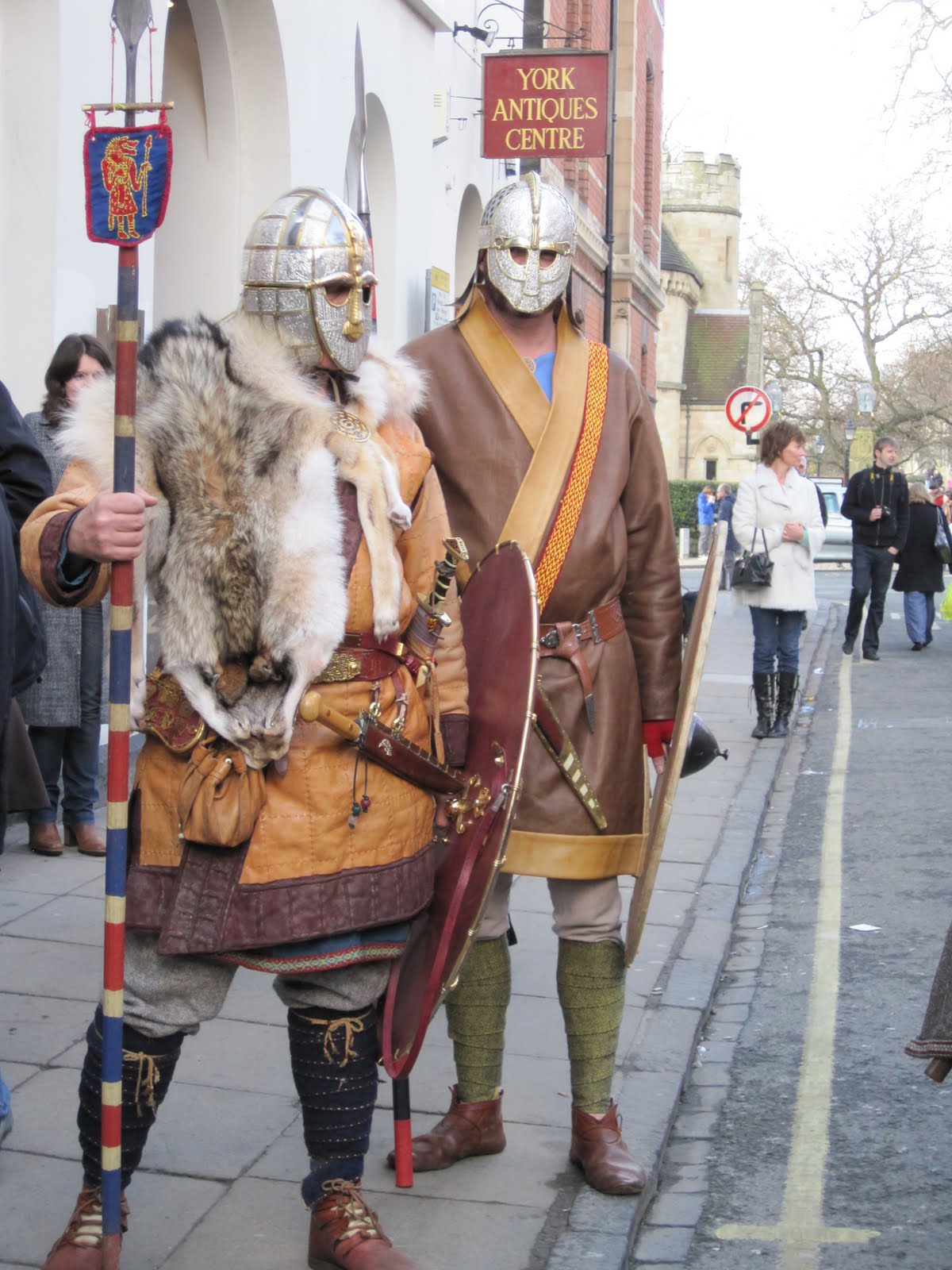
 The festival culminated in the Viking troops marching off for battle from the Museum Gardens, through the city of York and down to a lake outside of town for a ceremonial boat burning.


There they are, all lined up to go. There's actually three loooong lines of warriors- it was actually really impressive to see.

And there go the oft-forgot women & children, lugging all the supplies of course. The men have more important pillaging to do.

These two fine warriors were kind enough to stop for pictures with some kiddies.

Later that night to close the festival, they set a Viking boat on fire and set it adrift on the lake. I hear it was kinda neat and also involved standing around REALLY COLD for hours before they did so, but I wasn't there. I particularly enjoyed walking home and seeing all these dressed up Vikings going in and out of all the B&B's along my street and standing in line to checkout at the grocery store surrounded by Vikings. It was an interesting week :)

Thursday, March 4, 2010

The Battle of Stamford Bridge

I'm sure this is a surprise to absolutely no one, but I'm dreadfully behind in updating. Again. So here is the first part of a series of entries about Spring Term Field Trips to various fun and exciting places. Waaaay back in January I went with a group of CMSers to see Murton Park, Stamford Bridge, and the Hungate archaeological excavation.

Murton Park is an interactive living history museum that is actually super cool. While it is primarily targeted towards young kids around 8-9 as a field trip destination, they also run a variety of special programs for families, tourists, whatever. We got a behind the scenes look at what they do and how they do it. The museum covers a pretty large area of ground and has a variety of "sets" including a 1/5 scale model of a Roman fortress (which also doubles as the American Wild West for Western role-playing groups. I had no idea there were Brits running around pretending to be American gun-slinging cowboys! Apparently they also try to imitate the accent and it gets pretty funny according to the head of the museum.), a Celtic village, a Viking/Saxon/Medieval village, a Tudor farmhouse, and World War II home front air raid shelters. School groups show up to immerse the kids in a time period for a day. They get costumes and perform typical activities from the time period.

We had an interesting discussion with the head of the project about their philosophy there. He said that they were very careful to never adopt the approach of "and now children, we've traveled back in time and are now in XYZ year." Instead, they don't pretend that they have entered a different time period, they just learn about what life might have been like by performing some of the same tasks- candle making, weaving, farming, military practice (for the Romans anyway!). "Now we're going to take care of these fields using the same methods the Anglo-Saxons might have used." He was quite interesting and made some funny comparisons with Americans. He says we've all been raised in a society that embraces make-believe much more than Europe in general and the UK in particular. Americans are apparently quite content to go to Disneyworld and accept that they're in a magical kingdom with giant mice that will take pictures with you. Brits on the other hand scoff at the man in the mouse suit. So while "look we've entered a different time period" works on Americans, it won't on Brits. Interesting, especially since that is EXACTLY what the Jorvik Viking Museum ride does. Or at least what it did. It just reopened for the Viking Festival (more on that in another entry) and I don't know exactly what all they changed, but it is supposed to be much more authentic now. And I know some of the people that recorded the Old Norse voices! Mostly because they live in my house and CMS has the closest supply of people that study Old Norse.

Anyway, the whole thing was really cool. I actually think it would be really really cool to set something similar up in the States, but it'd be quite an undertaking. Murton Park lucked out because they were able to kind of coalesce with the Yorkshire Museum of Farming which originally held all the land the museum is located on when the Museum of Farming was having financial difficulties. And the staff are geniuses with working with what they've got- all of the sets are built by staff members out of whatever they can find. They also have probably the coolest dress up closet EVER. Tons and tons of historical clothes and props and weapons and helmets and plates and just tons of fun stuff to play with. The CMS theatre group, the Lords of Misrule, have been known to rent/borrow some stuff from them and according to a girl in the group, they had a bunch of fun digging through the stuff for costumes and props.

Next up, we headed off for an adventure in Stamford Bridge. The town was the site of the slightly-less-well-known battle of 1066 in which the British under Harold Godwinson, king of England for something like 10 months, defeated Harald Hardarda of Norway, who was pressing a claim for the throne of England. Meanwhile, William of Normandy (who I'm going to go ahead and call the medieval Risk player par excellance) was landing with a large invasion force in the south of England and immediately hunkered down and fortified their position and built a couple of castles, waiting for Harold to come to him. So Harold wins at Stamford Bridge and has to immediately begin a 2 week march through the entire freaking country to go try to defeat yet another claimant for his throne. Harold is defeated at the Battle of Hastings and William the Conqueror claims the throne of England, ushering in all kinds of changes to the formerly rather insular country. And there is your terribly oversimplified account of 1066, the one date pretty much any English person can tell you about. I suppose the closest parallel in American culture would be December 7th, 1941, a day that will live in infamy and all that. Personally I think it is kind of amusing how deeply entrenched outrage about 1066 is in English culture, especially since the Normans were the FOURTH group of people from the continent to take over England over the course of the middle ages (Romans, Angles & Saxons, Vikings, Normans- and all of these groups ended up settling in England permanently, so the majority of modern Brits are going to have some ancestors that came over from Normandy at some point). I think it rankles in particular because the Normans came from land that is now in France. (The country wasn't entirely unified in this period. Normandy functioned essentially as its own little country with only nominal deference to the King of France.) I use parentheses a lot, don't I? Maybe now would be a good time for pictures.

 
Here is our intrepid leader attempting to not get us lost through the maze of suburban housing developments. (we ended up lost anyway.)

Stamford Bridge is now a sleepy little suburban town. The bridge for which this is all named has moved over the years, but there is still a Stamford Bridge, as well as plenty of Viking/battle themed shop and street names. This should probably have been our first clue that this was not going to be a quick and easy sight seeing stop.

 
Here's a rendition of the battle as illustrated by three 10-year-olds posted on the walls of public loos. I thought it was cute :)

 You would think that a battle field would be marked, right? Not so much. After a bit of a detour through some neighborhoods and across some fields, we emerged upon the battlefield:


I particularly like the giant hedgerow that keeps you from seeing ANYTHING. Well, not that there's really much to see, its basically just a field. But I was there! Then we all headed back to town-this time only getting slightly lost- and grabbed a drink at the pub to warm up before heading back to King's Manor for lunch. After lunch, we got a tour of the excavation at Hungate, which at the time was snow-covered so we couldn't really see much. But some of their preliminary results are sounding pretty interesting- the area seems to have been used as essentially a waste dump for at least portions of the city for a long period of time.


And after THAT (this was a very long day...), we got to tour the various offices/departments at the York Archaeological Trust, including conservation, artifact identification, pottery, etc. The conservation work was pretty cool, especially since YAT takes on conservation jobs from other excavations as well as those done by YAT themselves so they get to see some interesting stuff. One of the projects they were working on was conserving and trying to identify some bones that might or might not be a medieval bishop who was supposed to be buried elsewhere. And then we all trudged home all the way across town and went to bed. (For reference, this trip took place the day after I got back to the UK and 2 days after a lot of people returned from abroad, so jetlag was not my friend that day!)

Tuesday, November 24, 2009

Wearmouth-Jarrow, or Kicking it with Bede

On Saturday, I headed up to Tyne & Wear to visit Wearmouth-Jarrow. But first of all, remember those pictures I posted from along the river? Well this was what that path looked like on Saturday.That's right, that would be it UNDER THE RIVER by the trees. Crazy flooding. Also, I just like this picture because I think the haze is kind of cool. Just ignore that weird spot towards the bottom left; sometimes my camera puts weird spots on things and I can't make it go away.

Right, so back to Wearmouth Jarrow. Wearmouth is home to St Peter's monastery, while Jarrow is home to St Paul's. They were both founded by the same guy and are considered to be essentially two branches of the same monastery. They also happen to be the UK's nominee for World Heritage Site 2010. We went to Jarrow in particular, because the World of Bede, a museum dedicated to arguably the UK's most famous medieval scholar and author, is housed nearby. Also, they were having a Christmas Fair. And that is exciting :)

To get there, we took the train from York up to Newcastle and then the metro out to Jarrow. While signs helpfully directed us the right way out of the metro station, the signs stopped abruptly right outside the metro station. So there was a bit of wandering in what we hoped was the right direction to find the place.

Here's a shot of a portion of the Wearmouth/Jarrow Way, a 12 mile trail connecting the two monasteries. They're only about 6 miles apart as the bird flies, but the roads meander a bit. I still can't believe how green everything still is.


Before hitting up the Christmas extravaganza and free admission to Bede's World, we stopped off at St Paul's and the church there. Ta da! Not terribly impressive from this angle, but then again, churches this old were kind of small, squat, thick-walled things, so that's only to be expected.


The front part is a Victorian addition to the original church dating back to 681. 681! The Anglo-Saxon church (pictured) now forms the chancel of the modern church, but originally seems to have been a chapel to Our Lady, obviously used by the monks of St Paul's. The Anglo-Saxon chapel includes 3 original windows and a tiny stained glass window has been reassembled from fragments found in excavations.


Around to the right are the extant ruins of the monastery, mostly dating to the 11th century. Bede lived at St Paul's in the late 7th, early 8th centuries, but alas that incarnation of the monastery was largely destroyed by the Vikings in 794.


I'm going to refrain from putting up more pictures of the ruins; I really ruins. I think its the archaeologist in me. But moving on.

We then headed up to the World of Bede for some craft/food/toys/etc stall browsing and some "edumacating."

Hee hee!
They had some nice replicas of Franks Casket, illuminated Bibles the size of a bed pillow, monks habits, etc. Can you imagine transporting this thing? I know there's nothing to show the scale, but take my word for it that it is about the size of a pillow, just thicker.


The Codex Amiatinus was produced in Northumbria (the medieval kingdom in modern day northern England) in the style of Roman illuminated Bibles as a gift to the Pope (and as a way to show off the skills of the Northumbrian scribes.) The real one is still in Italy and was actually only recently identified as a product of Northumbrian scholarship because the scribes did such a good job imitating Roman styles. It is unusual in that it is a manuscript of the entire Bible. When everything is handwritten on vellum, you can see how big a complete Bible gets. A collection of the Gospels or individual books of the Bible, such as a psalter, were much more common. The Codex is actually believed to be the earliest complete copy of the Vulgate Latin Bible. Go Northumbria. The reason they showcase it at the World of Bede is because it was commissioned and completed at Wearmouth-Jarrow, and it appears that Bede was likely involved in its compilation. Cool stuff :)

After wandering around there and buying Christmas gifts, we ventured out to the Anglo-Saxon replica farm, where they attempt to showcase how farming worked back in the day. Of course it was raining and muddy and most of the animals were taking cover, but it was kind of neat to walk around.


After successfully completing our medieval dork pilgrimage to Jarrow, we headed back to Newcastle in search of dinner and hung out at the pub until it was time to catch the train back to York. <3 cheap yummy fish and chips. Advantages to towns along the coast!