Showing posts with label Romans. Show all posts

Sunday, October 9, 2011

Hadrian's Wall, Part 3

After our stop in Stirling, we made a quick stop in Edinburgh to pick up some tartan for Ellen and then headed back home. On the return trip to York, we decided to approach from the west so that we could stop off along Hadrian's Wall from the other side and hopefully actually find some wall that still stands. Mission Accomplished!

Hadrian's Wall pt 2 (14) Hadrian's Wall pt 2 (12)

Roman ruins, check. It only took us three trips to Hadrian's Wall Country, but we finally found some of the wall actually still standing. Below is probably one of my all-time favorite pictures. We're a little goofy :)


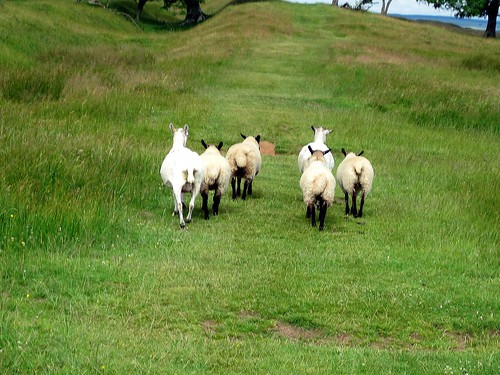
We hiked along the wall for awhile and made friends with some sheep. That's actually a pretty common occurrence for me in the UK/Ireland.

Hadrian's Wall pt 2 (21)
Hadrian's Wall pt 2 (23)


Past the train tracks, we eventually came to  this:

Hadrian's Wall pt 2 (25)

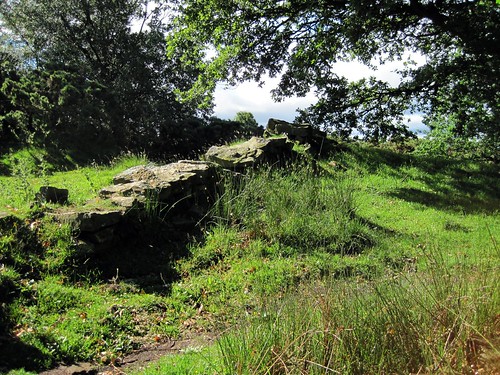
Poltross Burn, Milecastle 48. When the Romans built the wall, they equipped it with "castles" to fortify the wall against the "barbarians" from the North. Of course, since we were there, we took turns invading and defending the wall. I can't remember the final score, but if history is any example, the Celts won eventually. Poltross Burn is one of the best preserved milecastles left. It was built by the the Sixth Legion and was occupied until the fourth century by Roman auxiliary forces- locals recruited into serving with the army in return for Roman citizenship once they retired. While there isn't a whole lot of it left, there's enough to get a general sense of the floor plan, and considering this thing is over 1500 years old, that's pretty remarkable. You can even tell where the staircases once were, since there are still a few steps leading up to nowhere.


Hadrian's Wall pt 2 (8)

After we'd had our fill of Roman masonry, we decided it was dinner time. I don't remember if I mentioned this in the Illuminating Hadrian's Wall post or not, but when we were here for that, we caught the train in Haltwhistle. On our way back to the train station, we passed a Chinese takeaway place that looked pretty tasty. We had an hour or so before our train was going to come, so we could have stopped, but we were overly optimistic and thought we might be able to catch an earlier train home, so instead we rushed down to the station. Of course there was no earlier train, but by the time we found that out, we didn't have time to go back for Chinese food. We decided to remedy that on this visit. We weren't too far from Haltwhistle, and it was getting to be dinner time, so we decided we might as well make for a place we knew had food. And it was far and away the best Chinese I had in England. So if you're in Hadrian's Wall country, I definitely recommend hitting up Haltwhistle and the Chinese place right on the main street.

Hadrian's Wall pt 2 (6)

So that's it for the epic road trip of awesomeness. After dinner, we made our very slow way home via all kinds of twisty narrow roads, but eventually we did make it home. It was a truly unforgettable experience, and huge thanks to Rachel, Max, and Ellen for the excellent company, and Ellen did a great job driving a stick shift on the wrong side of the road!

Saturday, August 21, 2010

Edinburgh

Edinburgh Castle (14)

Behold, Edinburgh, Scotland's capital (and seat of the Scottish Parliament) and second-largest city behind Glasgow. Edinburgh lies in the southeastern part of Scotland along the Firth of Forth, which provides access to the North Sea. Our stay in Edinburgh was brief (dinner & a haunted graveyard tour and then the morning the next day), so we were limited in what we had time to do. The main districts in central Edinburgh are Old Town and New Town, both of which have been designated UNESCO World Heritage Sites by the way. We concentrated on Old Town, which includes Edinburgh Castle, the Royal Mile-- a high street shopping mecca for all things touristy or plaid (speaking of which, didya know using "plaid" to refer to a checked cloth is an American thing? I didn't.)-- St Giles Cathedral, and Holyrood Abbey/Holyroodhouse.

155

One of the first things you might notice approaching Edinburgh is Arthur's Seat pictured above. The hills here are the remnants of a long-extinct volcano, eroded by glacier activity long ago. The crag upon which Edinburgh Castle is located is another extinct volcano. There are good hiking trails if you want to climb to the peak of Arthur's Seat, or so I've heard, but alas we didn't have time to go check them out. There are a number of ancient hill forts nestled in the crags, including several thought to belong to the Votadini, who are recorded as one of the British tribes north of Hadrian's Wall during the Roman period. Add a few centuries of language change, and they were known as the Gododdin, who ultimately were defeated by the Angles as recorded in a poem from around 600 AD called Y Gododdin.

Edinburgh Castle


Speaking of Edinburgh Castle, ta da! Edinburgh Castle is built high on an imposing crag, dominating the city skyline. The site, chosen for obvious defensive features, has been inhabited for almost three thousand years, with the castle dating to at least the 1100s. This was the royal residence for the kings of Scotland until 1603, when the kingdoms of Scotland and England were united under one king, James VI of Scotland, who inherited the throne of England from Elizabeth I, thus becoming James I of England as well.

Edinburgh Castle 2 (3)


If you visit, be sure to be there before 1 pm to get a good spot to watch "Shannon the Cannon," a District Gunner with the 105th Regiment Royal Artillery, fire the One O'Clock Gun, a time signal originally used to notify ships in the Firth of Forth of the time. While most people crowd around the gun itself, you can get better views from the level above, outside St Margaret's Chapel. You'll want to scope out a spot about half an hour before hand, or befriend someone who did and get them to take pictures for you. I just went with awkward reaching around the heads of people in front of me.

185


The shopping thoroughfare leading up to the Castle is known as the Royal Mile. Here you can find all kinds of tartan, scarves, kilts, postcards, pipes, tobacco, etc etc etc. But from my not-so-extensive travels of Scotland, I'll just mention that you can find better deals on the same items outside of Edinburgh- Stirling has plenty of nice shops priced a bit cheaper, and if you're making a stop in Inverness up north, there are a few nice shops there with slightly better prices.You'll also probably find that prices are a bit better off the Royal Mile, which charges a premium as the center of tourist traffic. The one caveat to that statement, is Deacon Brodie's.

royal mile


Ok, yes, this is just a pub. Not so exciting you say. Well, sure, but it is absolutely adorable from the outside and on the inside, and has really good food for reasonable prices, especially for along the Royal Mile. During the lunch rush, they can take awhile to get your food prepared, but as long as you aren't in a rush, it is a great place to grab lunch or dinner. And conveniently located across the street from St Giles' Cathedral.

St Giles (27)


St Giles' is a lovely early Gothic building, with some lovely (but relatively young) stained glass. There has been a church on the site since the early Middle Ages, but the cathedral as it stands now was originally built in 1120s; at this point, it was likely relatively small, and would have been Norman (Romanesque if you're continental) in style. At some point it was rebuilt and expanded; this larger early Gothic building suffered damage from a fire in 1385 and was repaired and expanded into the building you see today.

St Giles (19)


Now, I've bemoaned the fact that most cathedrals do not allow photography inside on several occasions now. But here, I have nothing but praise. St Giles' does not charge admission to visit, but they do ask for a 2 pound donation if you want to take pictures. Totally reasonable, right? I don't know why more churches don't adopt this idea. Fantastic.

Greyfriar Bobby (3)


To wrap up Edinburgh, I figured I'd finish with a cute story. Here you see Greyfriars Bobby, a little Skye Terrier devoted to his owner. Now, there's several different stories, but the general story line goes that Bobby belonged to a member of the Edinburgh City Police (in some accounts, he was a watchmen for the Greyfriar Kirk, hence Greyfriar and a "bobby" in the UK is slang for a policeman) in the 1850s. Anyway, the dog's owner passed away, and for the next 14 years, Bobby guarded his master's grave until his own death. Sweet, right? Sadly, most of the story is embellished fiction, the creation of an American author who heard the story from a friend who had traveled to Scotland and heard the story there. And like any good game of telephone, much gets lost along the way. In actuality, it is most likely that the dog, who may have even just been a stray, stayed by the grave because a restaurant just outside the graveyard used to toss scraps over the gate into the cemetery. That, coupled with a stone bench thing just next to the grave in question, meant the dog had steady access to food and shelter. Ah well.

There's more photos from Edinburgh Castle, St Giles', and from a haunted cemetery tour we went on through Greyfriar's Graveyard up on flickr if you're interested. Until next time~

Wednesday, August 11, 2010

Hadrian's Wall Country, Part 1: The Approach from Newcastle upon Tyne

Hadrian's Wall pt 1

I'm finally (finally!) starting in on what I'm going to call the Epic Roadtrip of Awesomeness, July 2010. Five days, 4 grad students, 1 rental car, 3 tanks of petrol, some # of miles I didn't think to check before we returned the car, 1 big ole road atlas that became my near-constant companion, 3 memory cards full of pictures, and sadly no fried Twinkies or Mars Bars. There was haggis though!

Our first stop on the Epic Roadtrip of Awesomeness was a short hike along Hadrian's Wall Path, an 84-mile long National Trail that runs along- what else?- Hadrian's Wall. If you're interested in a brief overview of the wall, check out my Illuminating Hadrian's Wall entry (you can get to it from the Hadrian's Wall label off to the right sidebar.) We drove up from York and then detoured over from Newcastle towards Hadrian's Wall Country, found a place to pull over, and went for a hike.


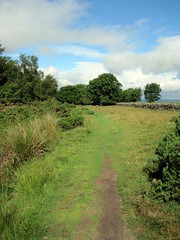
There's not really a whole lot of wall standing in this section of the trail, but you can follow the marked path along where the wall once ran. The less ancient stone fencing running through here is likely built from the stones of the wall. We lucked out and had gorgeous weather; it was supposed to just rain rain rain all week, but aside from a few fairly quick showers, all while we were driving, and a miserably wet and muddy field when we got to Culloden, the whole trip was surprisingly dry.


Even though there wasn't a fun wall to climb around on, we still got a welcome chance to stretch our legs and enjoy some scenery. We would have had to drive further out of our way to hit a section of wall still standing, so we decided to just enjoy what we had. The trail is easy to walk and well marked, although you may have to get up close and personal with some sheep.


There's more photos up on flickr if you feel the need for some more idyllic English countryside. But we were particularly excited about this:

Hadrian's Wall pt 1 (20) picnik'd

Trees! Most of Yorkshire is either moorland or gently rolling hills covered in crop fields. The presence of trees all closely packed together was kind of exciting and necessitated some frolicking :) Anyway, we hiked westward from almost the eastern-most end of the trail; there will be shots featuring actual wall from the western end of the wall coming from Carlisle to wrap up the Epic Roadtrip of Awesomeness series of posts, so I guess look for that in about 10 entries or so! Till next time~!

Friday, May 21, 2010

Gulhane Parki and the Archaeology Museum Complex (Istanbul part 2 of 7)

While the Aya Sofia and the Blue Mosque dominate Sultanahmet by virtue of being highly visible, Topkapi Sarayi (Topkapi Palace) is perhaps Sultanahmet's most impressive sight. The palace is tucked away within high walls, hidden until you enter into it. But Topkapi is a post (or three) in itself; here I'm going to focus on other things of note within these walls.

Immediately after passing through the high stone walls and pass through a bunch of food carts and then through a wrought iron fence, one comes upon Gulhane Parki, a public park that once served as the grounds and gardens of the sultans living at Topkapi.

The park is a great place for some downtime between hectic sightseeing, and plenty of trees provide some much appreciated shade during the heat of the afternoon.


I thoroughly enjoyed parking my tired self on a bench and munching on baklava and people-watching for an hour. There are also several museums within the huge sprawl of the park, most notably the Archaeology Museum Complex. 10 TL gets you into the Archaeology Museum itself, as well as the Museum of the Ancient Orient and the Museum of Turkish Ceramics.


The three musuems are centered around a "column garden" courtyard (also a good place for some shade) and are open until 7 pm, a bit later than most places.

The Archaeology Museum is the best of the three in my opinion, and has some really neat stuff you won't find in most museums. Sure they've got your basic Greco-Roman style sculpture:


and some mosaics:


and some Roman soldiers:


But what is really cool about the museum is their Sidon collection. Sidon was a major Phoenician city way back in the day (you can thank them for the alphabet), now in modern Lebanon. Excavations in the 19th century turned up some fantastic tombs and sarcophagi reflecting a broad range of artistic styles and influences, and showcasing just how cosmopolitan the Phoenicians and Sidon in particular were. 


This is the Alexander Sarcophagus, named for its depictions of Alexander fighting the Persians on one of the long sides and hunting with them on the other. The tomb was originally thought to have housed Abdalonymus, king of Sidon appointed by Alexander, but that has since been challenged, so it may have belonged to a Persian noble & governor of Babylon instead. But what's great about it is how much of the original pigment survives.

You can still make out the orange in the hair of the man riding the horse, along with the yellow of his cloak and the red in the cloth on the arm of the man behind him. In fact, enough paint has survived to allow a reconstruction of what the image might have looked like to be created. The recreation is from the opposite side of the sarcophagus.

(G.dallorto derived from MatthiasKabel derived from Marsyas via Wikipedia)

The Lycian tomb, above, also comes from the necropolis at Sidon, but less is known about it. Basically, it is monumental, belonged to somebody important, and features the pointed arch lid characteristic of Lycian tombs.

The museum's collections continue upstairs, with artifacts from Istanbul through the Ages, and more material collected from throughout what used to be the Ottoman Empire, including a number of finds from excavations at Troy. They also hold the Kadesh Peace Treaty, believed to be the oldest surviving peace treaty in the world, dating back to 1258 BC and signed by Egyptian Pharaoh Ramses II and Hattusili III of the Hittite Empire. The archaeologist in me appreciated this shot:

What do you do with the massive amounts of pottery sherds dug up in excavations? Stick them on the overhang between two floors of the museum! 

Definitely worth a visit, and since it is open late, can be combined with a visit to Topkapi Sarayi no problem, especially if you take a break to enjoy a snack and relax in Gulhane Parki.

Thursday, May 20, 2010

Yerebatan Sarnici (Istanbul part 1 of 7)

Ok, here we go: time for Cimby's adventures in Not!UK. After the volcano messed with my travel plans over spring break, I rescheduled my flight to Istanbul for the first week of May (thus missing Istanbul's Tulip Festival, but oh well). If you've been harassing me about pictures- you know who you are!- the ones I like are up on flickr. I probably won't be putting much up on facebook from here on out because their privacy changes kind of scare me, so flickr's the place for photos since I coughed up the dough for a pro account. I recommend flicking through the Istanbul set rather than going through the photostream because I tend to caption the first picture of a place rather than each one individually, so if you're wondering what something is, check the captions. Or just wait until I get around to writing a blog entry about it!

So I pack up my trusty rucksack (I swear, I'm going to come home and sound ridiculous spouting all these British-isms. Like last time I was home and I thanked the sales person ringing up my purchase with "Cheers" and got a funny look) and headed off to the train station at an uncomfortably early hour. Three hours, three trains, and a bus later and I was at London's Luton airport, which, by the by, is not even really all that close to London, but I digress. A Krispy Kreme, security checkpoint, and 2 hours later, I was on a plane for Turkey!

I flew in and out of Istanbul's second airport, Sabiha Gokcen, named after the first female combat pilot in the world, and the adopted daughter of Ataturk, the founder/1st president of the Republic of Turkey, who lends his name to Istanbul's OTHER airport. Nice to see them keeping it a family affair. Anyway, by flying in and out of Sabiha, for a grand total of like 3 hours, I was in Asia! See? Don't you love when I get all creative with MS Paint? ;)


Istanbul is actually divided into three by the Bosphorus (above) separating European Istanbul and Asian Istanbul, and the Golden Horn, an inlet of the Bosphorus running off the the left of the photo, dividing European Istanbul into northern and southern halves. If I'd had more time, I'd love to have run around the Asia side, but I figured I should hit up the major sights in what time I had.

Now obviously I have never had a gift of conciseness in these entries, but there are some coming up that might just take the cake, so I thought I'd start off easy with Yerebatan Sarnici or the "Basilica Cisterns" for something relatively short & sweet.


I wish that stupid post wasn't there. This is actually the exit- to enter you'd need to go around the corner and across the street, but it is well marked. Like most of the big tourist draws, Yerebatan is in the Sultanahmet district in the Old City on the European side of the city. This makes getting from place to place pretty easy, since most of what you'll want to see in Istanbul is in one walkable area, but it also means that the area is studded with tourist traps, overpriced food, street vendors, and junky souvenirs. Not that I bought any of that. Of course. Moving on.

The cisterns were built by Justinian in the sixth century AD and served as the main water supply for the Byzantine Great Palace and then later for Topkapi Palace. After the Ottomans took over, the cistern fell into disuse and was forgotten by pretty much everyone but the locals, who had wells down into from the houses above and used to fish in it. A Frenchman "rediscovered" it for the tourists in the 1500s when he became curious about where the locals were getting the fresh fish they were selling in the area. And from that point on, it became a tourist attraction.


Originally tourists would take little boats through the columns and marvel that this exists beneath the busy streets of Istanbul. Nowadays, tourists walk along a raised platform and admire the ambiance of mysterious columns illuminated with colored lights and mood music. I'm being somewhat facetious, but in all honesty it is a really cool place to visit, and probably my favorite of the things I did. And, bonus, only 10 Turkish Lira (TL). That's like 4 pounds! I loved the conversion rate while I was there. It was really exciting to realize that I was having a delicious lunch for less than 2 pounds- things like that.


And here's the guys who started it all, the fish.


There's even a cafe down there if you fancy a cuppa while admiring the Byzantine engineering. It is particularly neat because the columns don't seem to have been custom made for the project, but were instead recycled from various other buildings/leftovers, so there is a great variety in the columns themselves to check out. This column is perhaps the oddest- and therefore coolest- of the bunch.


There's also two more oddities in a corner:


Two column bases feature carved heads of Medusa. These were apparently brought to the cistern from elsewhere, obviously from some sort of Roman building. It is thought that the heads were placed sideways and upside down in order to somehow negate the power of her gaze, but it can also be argued that the base is just more stable this way.

The place is huge, along the lines of a decent-sized cathedral, with 336 columns supporting the ceiling. Definitely worth a walk through; doesn't take too long to see, but certainly a unique experience.

Wednesday, March 31, 2010

Chester

Welcome to Chester, England, located just this side of the border with Wales and a 2.5-3 hour train ride from York. And if you get advance pricing with a student/under 25 pass, only 8 pounds each way.

Chester is known as England's "Walled City" because it has the most intact city walls remaining. Chester was founded by the Romans as a fort called Deva Victrix. Fun fact: while York eventually became more important as essentially the headquarters of the Roman legions in the North, the fortress at Deva Victrix was actually bigger than the one at York.

 This is what remains of the foundations and a tower from the Roman fortress. You can click on the picture to see an enlarged version if you want to read the plaque.

The citizens of Chester have put their Roman past to use in the picture below from the Roman Column Garden.


After the Romans left Britain after 490, the Anglo-Saxons fortified the town against the Danes and it remained a stronghold through to the Norman Conquest in 1066, when it was one of the last cities to fall to William the Conqueror. The walls were instrumental for both cases.


What I found interesting about Chester's walls (which you don't see at York) is that one can access the buildings adjacent to them FROM the walls. Most of these are shops, and while some are 2 stories and can be accessed from street level in the front and wall level in the back, some can ONLY be accessed from the walls (mostly smaller shops- books, antiques, that kind of thing.) I found that really useful when Britain, being Britain, decided to absolutely pour down rain about 10 minutes into my circuit of the walls.


Here you can see some shop entrances- New Look, HSBC, and Clarks. You can also see the steps leading up to Eastgate, one of the original Roman entrances to the fortress (sort of analogous to the "bars" in York, only much less grand.) This one was rebuilt in the 18th century and that clock on top was commissioned in honour of Queen Victoria's Diamond Jubilee (60 years as queen) in 1897.

I went off to Chester because a) I could get there cheaply over the break and b) we talked about it in my archaeology class because it has a unique structural feature, the rows.

 This is my own version of perhaps Chester's most photographed site on the corner of what's called the Cross (an intersection of shopping streets with rows more or less preserved). So what are the rows? Well, they consist of three main floors (and might have attic space above that as well.) The first level is generally half a story below street level, so you go down a few steps to enter the shop. Above the ground floor, a covered walkway is reached by a short flight of stairs and a second row of shops is located a few feet back from the edge. A third floor is built at the same point as the ground floor, effectively covering the walkway. This top floor would have been used in the medieval period as domestic or storage space for the shop owners. This gives you a better idea of what the covered walkway and second floor of shops looks like.

(Yanked from Wikipedia because I didn't think to take one; copyright John S Turner)

As I mentioned, the rows are unique and it is unclear where exactly the idea came from. While large portions have been rebuilt over the years, some sections and the original plan dates back to the medieval period. One theory that has gained ground with archaeologists is that the second storey was constructed first on top of rubble from Roman construction that lined the streets below. The buildings were set back from the edge in order to allow for a footpath along the edge with the road below. Later, undercrofts were dug under the existing buildings, thereby creating the "street-level." Then as construction techniques improved, the top storey was added, thereby creating the enclosed walkways. An alternate theory holds that the citizens constructed stone undercrofts under timber buildings after a disastrous fire in the 13th century destroyed most of the buildings within the stone walls of the city. Personally I don't think this explains why the first floor is below street level, or the need for recessed second floor shops with a covered walkway. That plus the amount of Roman "stuff" found all over Chester makes the first theory more supportable in my opinion, but who knows.

Chester is mainly known as a shopping mecca, both for its central pedestrian area with rows and regular shops as well as for an outlet mall just outside the city. But I refrained from buying too much (and to be fair, I needed the new sunglasses. Although not this week- rain rain rain.) You may have noticed the prevalence of black and white architecture in my photos- this is also one of Chester's selling points. Some of it is legit medieval, but a good deal is Victorian. They say if you wait long enough, everything comes back into style, right? Apparently that goes for 500 year old architecture too!

The photo I opened this entry with, of the Westminster Hotel? Not original (obviously). These, however, I'm pretty sure are.


Oh, and how about this? Guessing game time. What type of building do you think is pictured below? The text reads "The fear of the Lord is a Fountain of Life."


If you guessed "Dentist's Office" you'd be correct. Bet you didn't though ;)

As far as NON black and white architecture goes, the town hall and the cathedral are major.


Now that's a pretty spiffy town hall.


I know the cathedral looks kind of dark and grim, but that's mostly due to the fact that I took this from the wall in the pouring rain. You can go in and check it out, for an entrance fee. I figured I've seen my fair share of cathedrals and could save the entrance fee for something else. Like the chai tea latte I bought at Starbucks to get out of the rain!

Finally, I wish I could show you the Roman amphitheater. But it is currently all fenced off for conservation work. (In fact, I walked right past it twice without realizing it was there before I followed a map to look for it. Whoops!) So this is the best I can do.


Final thoughts on Chester: cool for an afternoon shopping trip, but maybe not worth a special trip. The majority of the shops are chains you can find in any decent sized city/town in the UK, so really the architecture is the big draw. But it is one more place I can check off my list and the closest to Wales I've gotten. Chester is actually serviced by the Arriva train line that operates out of Wales, so it was kind of cool to see the stations on the scrolling light thing in the train listed in both Welsh and English. The destination of the train was Llandudno. Don't ask me to pronounce it. Apparently it is a nice sea-side resort in Wales.

But the most exciting recent happening is this:
Ah, American food. A source of joy I will never take for granted again. Snack crackers, how I adore thee. In a land where potato crisps are your only option for savory snacks, you are a beacon of hope for this expat. Ditto to you Cinnamon Toast Crunch. You shine with a glimmer of sugar amidst a whole slew of boring plain cereal. And marshmallows- your squishy deliciousness unknown in these parts will be greatly enjoyed with your friends the graham crackers and some native English chocolate as s'mores at our next bbq. Apple sauce- you are not chunks of apple in a sauce meant to garnish meat. Rather you are smooth and delicious in your own right, and how I have missed you. Reeses- you know chocolate and peanut butter is the most delicious combination ever (with the occasional exception of Nutella and peanut butter). Aunt Jemimia- I'm not sure I've even had you in years. We're a Bisquick family. But I will take you over their strange idea of what pancakes are here. Pancakes should be a delicious breakfast food (or breakfast-for-dinner food) topped with maple syrup, not used as, well, basically a thick crepe. And finally, Blue Box. I don't even normally like you that much. I tend to favor other brands more, although Easy Mac is darn tasty and so easy! But in a land where "cheese sauce" of questionable cheesiness passes for cheese, I will enjoy you immensely. At least until you are gone. Then I will remember you fondly and probably order more.