Ok, here we go: time for Cimby's adventures in Not!UK. After the volcano messed with my travel plans over spring break, I rescheduled my flight to Istanbul for the first week of May (thus missing Istanbul's Tulip Festival, but oh well). If you've been harassing me about pictures- you know who you are!- the ones I like are up on flickr. I probably won't be putting much up on facebook from here on out because their privacy changes kind of scare me, so flickr's the place for photos since I coughed up the dough for a pro account. I recommend flicking through the Istanbul set rather than going through the photostream because I tend to caption the first picture of a place rather than each one individually, so if you're wondering what something is, check the captions. Or just wait until I get around to writing a blog entry about it!
So I pack up my trusty rucksack (I swear, I'm going to come home and sound ridiculous spouting all these British-isms. Like last time I was home and I thanked the sales person ringing up my purchase with "Cheers" and got a funny look) and headed off to the train station at an uncomfortably early hour. Three hours, three trains, and a bus later and I was at London's Luton airport, which, by the by, is not even really all that close to London, but I digress. A Krispy Kreme, security checkpoint, and 2 hours later, I was on a plane for Turkey!
I flew in and out of Istanbul's second airport, Sabiha Gokcen, named after the first female combat pilot in the world, and the adopted daughter of Ataturk, the founder/1st president of the Republic of Turkey, who lends his name to Istanbul's OTHER airport. Nice to see them keeping it a family affair. Anyway, by flying in and out of Sabiha, for a grand total of like 3 hours, I was in Asia! See? Don't you love when I get all creative with MS Paint? ;)
Istanbul is actually divided into three by the Bosphorus (above) separating European Istanbul and Asian Istanbul, and the Golden Horn, an inlet of the Bosphorus running off the the left of the photo, dividing European Istanbul into northern and southern halves. If I'd had more time, I'd love to have run around the Asia side, but I figured I should hit up the major sights in what time I had.
Now obviously I have never had a gift of conciseness in these entries, but there are some coming up that might just take the cake, so I thought I'd start off easy with Yerebatan Sarnici or the "Basilica Cisterns" for something relatively short & sweet.
I wish that stupid post wasn't there. This is actually the exit- to enter you'd need to go around the corner and across the street, but it is well marked. Like most of the big tourist draws, Yerebatan is in the Sultanahmet district in the Old City on the European side of the city. This makes getting from place to place pretty easy, since most of what you'll want to see in Istanbul is in one walkable area, but it also means that the area is studded with tourist traps, overpriced food, street vendors, and junky souvenirs. Not that I bought any of that. Of course. Moving on.
The cisterns were built by Justinian in the sixth century AD and served as the main water supply for the Byzantine Great Palace and then later for Topkapi Palace. After the Ottomans took over, the cistern fell into disuse and was forgotten by pretty much everyone but the locals, who had wells down into from the houses above and used to fish in it. A Frenchman "rediscovered" it for the tourists in the 1500s when he became curious about where the locals were getting the fresh fish they were selling in the area. And from that point on, it became a tourist attraction.
Originally tourists would take little boats through the columns and marvel that this exists beneath the busy streets of Istanbul. Nowadays, tourists walk along a raised platform and admire the ambiance of mysterious columns illuminated with colored lights and mood music. I'm being somewhat facetious, but in all honesty it is a really cool place to visit, and probably my favorite of the things I did. And, bonus, only 10 Turkish Lira (TL). That's like 4 pounds! I loved the conversion rate while I was there. It was really exciting to realize that I was having a delicious lunch for less than 2 pounds- things like that.
And here's the guys who started it all, the fish.
There's even a cafe down there if you fancy a cuppa while admiring the Byzantine engineering. It is particularly neat because the columns don't seem to have been custom made for the project, but were instead recycled from various other buildings/leftovers, so there is a great variety in the columns themselves to check out. This column is perhaps the oddest- and therefore coolest- of the bunch.
There's also two more oddities in a corner:
Two column bases feature carved heads of Medusa. These were apparently brought to the cistern from elsewhere, obviously from some sort of Roman building. It is thought that the heads were placed sideways and upside down in order to somehow negate the power of her gaze, but it can also be argued that the base is just more stable this way.
The place is huge, along the lines of a decent-sized cathedral, with 336 columns supporting the ceiling. Definitely worth a walk through; doesn't take too long to see, but certainly a unique experience.
The musings, cultural experiences, photos, trials, and tribulations of an American grad student studying medieval history, traveling as much as a grad student budget allows, and drinking lots of tea in the process.
Thursday, May 20, 2010
Wednesday, May 19, 2010
Pictures & such
You may have noticed there are Istanbul pictures up on flick. Rather a lot of them. I did try to put captions on them, but they'll make more sense if you go through the set rather than the photo stream, which messes up the ordering. I've got a presentation for a dissertation workshop tomorrow, and then Harry Potter train (finally!) in the next couple of days, and then possibly the Lake District at the end of the month, so busy busy busy, but I'll start in on Istanbul posts in the next couple of days, hopefully.
Meanwhile, I've been having way too much fun messing around with GIMP photo editing software. My favourite new trick? Going from this:
to this:
Jaa, mata~
Meanwhile, I've been having way too much fun messing around with GIMP photo editing software. My favourite new trick? Going from this:
to this:
Jaa, mata~
Wednesday, May 12, 2010
Odds and Ends (London, part 9 of 9)
I'm going to go ahead and call this the last of the London posts. This will just be a few assorted pictures that didn't necessarily deserve their own post, but were still pretty neat.
The ubiquitous double-decker red buses. A few of the old school ones are still out and about, but for the most part, they have been replaced with these shinier newer versions.
And the standard red British telephone boxes. Sadly not as common as they once were, which is true for pay phones everywhere I suppose. I remember the days back before cell phones (or mobile phones if you're British) became popular and my mom (hi Mom!) made me carry around 50 cents for a pay phone call.
A lot of London neighborhoods, particularly the older ones/the ones that were more fashionable back in the day are centered around these little square gardens. This particular example is Russell Square near the British Museum and the University of London.
Space toilet! These things are all over travel shows for London, but this one was honestly the only one I saw. You have to pay to go in, but it does this whole magical disinfecting thing so you know it will be theoretically clean. And no, I didn't try it.
Who knew train stations could be so pretty? This is London St Pancras station, located just across the street from King's Cross. St Pancras is the London hub of the Eurostar, the train that goes through the Chunnel to France. It is also _really_ nice inside the station. King's Cross, the main London station for UK train service, is not nearly so nice.
The tube! Also called the underground, but never called the subway. In Britain, a subway is an underground walkway, usually via tunnel, built to allow pedestrians to bypass a busy intersection or to get from one side of a big highway to the other. The underground is awesome and I love it. Way more efficient than the MBTA up in Boston or the Metro in DC. The longest I had to wait for a train was 3 minutes, and each station has electronic displays to notify you of how long until the next train arrives. And with an Oyster Card, a preloaded plastic card much like a metro card or a Charlie Card (DC & Boston respectively), taking the tube is super affordable and easy-peasy. Plus, anywhere in London, you will be near a tube station, and the iconic Underground map is really easy to understand, so it is easy to navigate, affordable, and super tourist friendly. If you do get confused, there are staff on hand at every station to help you figure out how to get where you want to go.
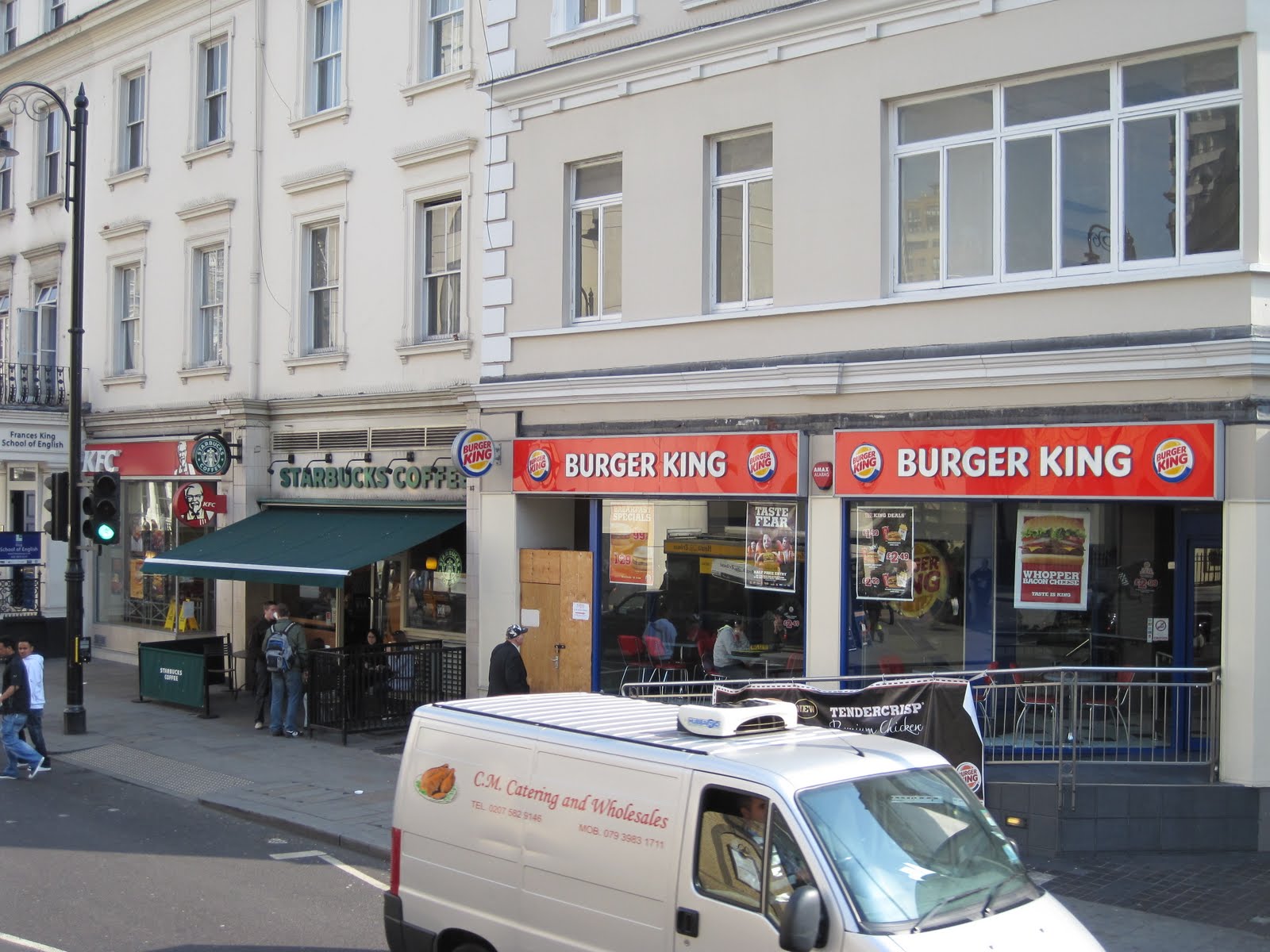
Hello, American chains! You'll often find Burger King, Starbucks & KFC (often accompanied by Pizza Hut) overseas, and often in a row like this. I personally don't go to any of them unless I can help it because it makes me cringe thinking about how much cheaper any of these places would be in the States.
This is the Marble Arch, located kittycorner to Speakers Corner in Hyde Park. The Arch was once an entrance to Buckingham Palace from the Mall (see the Trafalgar Sq. post), but was later moved here. If you've ever read any 18th century chick lit, you'll be familiar with Hyde Park, where everyone who is everyone goes to see and be seen.
This end of the park opposite the Marble Arch is known as Speakers' Corner, where every Sunday, anyone with something to say can stand on a soapbox (or other device of your choice, but you have to be standing on something to elevate your height by at least 6") and speak to the masses. Anything is fair game, although the police may warn you about excessive profanity usage. But watch what you say about the Queen, but it is still treason to insult her here. (Now I'm totally envisioning Eddie Izzard standing here singing that "God Attack the Queen" bit from his Dressed to Kill routine.)
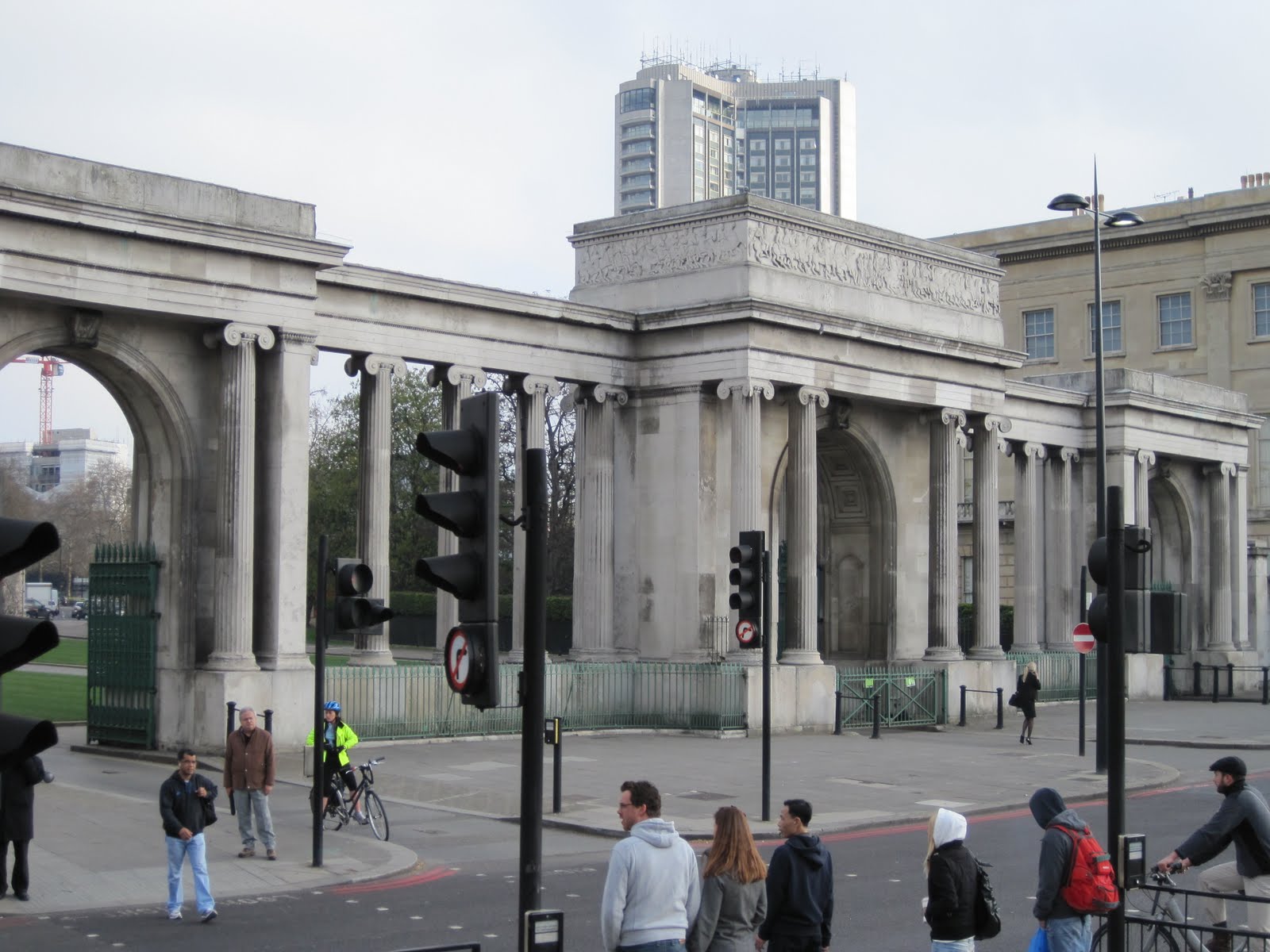
This is meant to be the big grand entrance to the Park, but of course with a park as big as Hyde Park, it is difficult to really have one "main" entrance.
Marble Arch is located on the north end of Hyde Park, while the Wellington Arch (pictured below) marks the south end.
Until 1992, the Wellington Arch was the second smallest police station in London, with one located in Trafalgar Square beating it out for the smallest.
Here's a close up of the quadriga on top of the arch. It shows the angel of peace descending on the chariot of war. It is also the largest bronze statue in Europe. Right in front of the Wellington Arch is the Royal Artillery Memorial.
The memorial honours the casualties of the British Royal Regiment of Artillery from World War I. It was one of the first memorials to use realistic depictions of war and caused a good deal of controversy when it was unveiled. During the war years, the British government outlawed all images of dead soldiers, but the monument includes a depiction of one laid out for burial in defiance of censorship laws at the time because the creator felt it was important to bring the reality of the war home to the British people.
This is Apsley House. Address: 1 London. Ok, so officially it is 149 Piccadilly, but the house has been referred to as Number One, London for over 200 years because it was the first London building people coming in from the countryside saw/passed. This was the home of the Duke of Wellington. There is a statue of him just across the street in the park.
Speaking of statues, over in Piccadilly Circus is a particularly well-known one.
The statue of Eros is very well-known in London. It even shows up on most maps because it is a really handy landmark. Except that it isn't a statue of Eros at all! The statue tops the Shaftesbury Monument Memorial Fountain built in honour of Lord Shaftesbury, a well-known Victorian era philanthropist. And that statue itself? It is actually meant to be Anteros, Eros's brother and the god of selfless love or requited love. When the statue was put up, some people were kind of offended by the fact that he's nude and a pagan god, so then everyone started calling it a statue of the Angel of Christian Charity. The name never stuck, and people just called it the Eros statue.
This is Cleopatra's Needle. It is a legit Egyptian obelisk, which kind of irritates me because it is out eroding in the rain and smog of London. Hence the scaffolding you can kind of see at the bottom between all the tree branches. The obelisk is part of a pair; its mate is now in New York City's Central Park. The two came from Heliopolis originally and date back to around 1450 BC. About a thousand years later, they were moved to Alexandria by the Romans during the reign of Augustus. So they actually have nothing whatsoever to do with Cleopatra. Flanking the obelisk are two statues of sphinxes.
The sphinxes were originally intended as guardians of the Needle, but apparently that message wasn't passed on to whoever they contracted to install the things. Instead of facing away from the needle to watch whoever might approach, the two sphinxes spend their days staring at the needle instead.
And how about this really ugly concrete building? This my friends, is the American Embassy in London. Recently added to the list of protected buildings for its "interesting use of concrete." That's right, our embassy is so ugly, it can now never be renovated to be less ugly. But not to worry, the US has plans for a new embassy further outside of town and have plans in place to sell this one.
And with that, I declare the run of entries about London over. Sure there is more I could say and more pictures I could put up, but I think that'll do. We'll start in on Istanbul later.
The ubiquitous double-decker red buses. A few of the old school ones are still out and about, but for the most part, they have been replaced with these shinier newer versions.
And the standard red British telephone boxes. Sadly not as common as they once were, which is true for pay phones everywhere I suppose. I remember the days back before cell phones (or mobile phones if you're British) became popular and my mom (hi Mom!) made me carry around 50 cents for a pay phone call.
A lot of London neighborhoods, particularly the older ones/the ones that were more fashionable back in the day are centered around these little square gardens. This particular example is Russell Square near the British Museum and the University of London.
Space toilet! These things are all over travel shows for London, but this one was honestly the only one I saw. You have to pay to go in, but it does this whole magical disinfecting thing so you know it will be theoretically clean. And no, I didn't try it.
Who knew train stations could be so pretty? This is London St Pancras station, located just across the street from King's Cross. St Pancras is the London hub of the Eurostar, the train that goes through the Chunnel to France. It is also _really_ nice inside the station. King's Cross, the main London station for UK train service, is not nearly so nice.
The tube! Also called the underground, but never called the subway. In Britain, a subway is an underground walkway, usually via tunnel, built to allow pedestrians to bypass a busy intersection or to get from one side of a big highway to the other. The underground is awesome and I love it. Way more efficient than the MBTA up in Boston or the Metro in DC. The longest I had to wait for a train was 3 minutes, and each station has electronic displays to notify you of how long until the next train arrives. And with an Oyster Card, a preloaded plastic card much like a metro card or a Charlie Card (DC & Boston respectively), taking the tube is super affordable and easy-peasy. Plus, anywhere in London, you will be near a tube station, and the iconic Underground map is really easy to understand, so it is easy to navigate, affordable, and super tourist friendly. If you do get confused, there are staff on hand at every station to help you figure out how to get where you want to go.
Hello, American chains! You'll often find Burger King, Starbucks & KFC (often accompanied by Pizza Hut) overseas, and often in a row like this. I personally don't go to any of them unless I can help it because it makes me cringe thinking about how much cheaper any of these places would be in the States.
This is the Marble Arch, located kittycorner to Speakers Corner in Hyde Park. The Arch was once an entrance to Buckingham Palace from the Mall (see the Trafalgar Sq. post), but was later moved here. If you've ever read any 18th century chick lit, you'll be familiar with Hyde Park, where everyone who is everyone goes to see and be seen.
This end of the park opposite the Marble Arch is known as Speakers' Corner, where every Sunday, anyone with something to say can stand on a soapbox (or other device of your choice, but you have to be standing on something to elevate your height by at least 6") and speak to the masses. Anything is fair game, although the police may warn you about excessive profanity usage. But watch what you say about the Queen, but it is still treason to insult her here. (Now I'm totally envisioning Eddie Izzard standing here singing that "God Attack the Queen" bit from his Dressed to Kill routine.)
This is meant to be the big grand entrance to the Park, but of course with a park as big as Hyde Park, it is difficult to really have one "main" entrance.
Marble Arch is located on the north end of Hyde Park, while the Wellington Arch (pictured below) marks the south end.
Until 1992, the Wellington Arch was the second smallest police station in London, with one located in Trafalgar Square beating it out for the smallest.
Here's a close up of the quadriga on top of the arch. It shows the angel of peace descending on the chariot of war. It is also the largest bronze statue in Europe. Right in front of the Wellington Arch is the Royal Artillery Memorial.
The memorial honours the casualties of the British Royal Regiment of Artillery from World War I. It was one of the first memorials to use realistic depictions of war and caused a good deal of controversy when it was unveiled. During the war years, the British government outlawed all images of dead soldiers, but the monument includes a depiction of one laid out for burial in defiance of censorship laws at the time because the creator felt it was important to bring the reality of the war home to the British people.
This is Apsley House. Address: 1 London. Ok, so officially it is 149 Piccadilly, but the house has been referred to as Number One, London for over 200 years because it was the first London building people coming in from the countryside saw/passed. This was the home of the Duke of Wellington. There is a statue of him just across the street in the park.
Speaking of statues, over in Piccadilly Circus is a particularly well-known one.
The statue of Eros is very well-known in London. It even shows up on most maps because it is a really handy landmark. Except that it isn't a statue of Eros at all! The statue tops the Shaftesbury Monument Memorial Fountain built in honour of Lord Shaftesbury, a well-known Victorian era philanthropist. And that statue itself? It is actually meant to be Anteros, Eros's brother and the god of selfless love or requited love. When the statue was put up, some people were kind of offended by the fact that he's nude and a pagan god, so then everyone started calling it a statue of the Angel of Christian Charity. The name never stuck, and people just called it the Eros statue.
This is Cleopatra's Needle. It is a legit Egyptian obelisk, which kind of irritates me because it is out eroding in the rain and smog of London. Hence the scaffolding you can kind of see at the bottom between all the tree branches. The obelisk is part of a pair; its mate is now in New York City's Central Park. The two came from Heliopolis originally and date back to around 1450 BC. About a thousand years later, they were moved to Alexandria by the Romans during the reign of Augustus. So they actually have nothing whatsoever to do with Cleopatra. Flanking the obelisk are two statues of sphinxes.
The sphinxes were originally intended as guardians of the Needle, but apparently that message wasn't passed on to whoever they contracted to install the things. Instead of facing away from the needle to watch whoever might approach, the two sphinxes spend their days staring at the needle instead.
And how about this really ugly concrete building? This my friends, is the American Embassy in London. Recently added to the list of protected buildings for its "interesting use of concrete." That's right, our embassy is so ugly, it can now never be renovated to be less ugly. But not to worry, the US has plans for a new embassy further outside of town and have plans in place to sell this one.
And with that, I declare the run of entries about London over. Sure there is more I could say and more pictures I could put up, but I think that'll do. We'll start in on Istanbul later.
Monday, May 10, 2010
Westminster area (London part 8 of 9)
Behold, Big Ben! NOT! Big Ben is the bell that hangs out in that clock tower, not the tower/clock itself. I have about a million (ok, more like 20. But still a lot) pictures of the tower, so it was a challenge to pick just one. The tower anchors one end of the Palace of Westminster, which serves as the home of both houses of Parliament, the House of Lords and the House of Commons. Once upon a time, there was another Palace of Westminster, but it burned down in the 1800s, and the current building was constructed.
I think it is quite pretty. You can visit Parliament and even observe politics happening in the two houses, but the building is only open when Parliament is in session. They are usually there rather late at least one day a week, which makes this a great place to visit after 5 pm when most things close down. Sadly, I was there after Gordon Brown, the Prime Minister, resigned his Parliament, so everything was closed down until after elections. British politics are quite different from our own since it is a multi-party system.
To broil it down to the most basic level, basically elections are held for the seats in the House of Commons, while the members of the House of Lords are drawn from the nobility (either elected from the ranks of eligible hereditary lords by the members of the aristocracy who once held a seat in the house by privilege of their rank) and from the higher-ups of the Church of England, namely the archbishops and a number of high ranking bishops, and include a number of appointed members whose descendants do not get hereditary right to be considered for the House. Anyway, once elections for seats are held, whichever party holds the majority of seats is the party from which the Prime Minster is chosen by the Queen; usually she picks whoever happens to be the head of that particular party. The problem comes in when no one party holds a majority (i.e. like right now as election turmoil still rages). When this happens, two or more parties will try to put together a "coalition" government. They'll be buddy buddy and work together and then the Queen gets to pick who she thinks will be the most successful to form a successful government (usually the leader of the largest party in the coalition). As a result of the general election held just last week, the parties are trying to jockey into position and get a coalition government formed. Oh, and did I mention that there is no set time frame for elections to occur? Parliament can cast a vote of no confidence in the current government under the leadership of the Prime Minster and force an election. Or, the Prime Minster can resign his government as no longer functional and force elections. Anyway, the point of all of that was that it would probably be pretty cool to check out the Palace of Westminster, but try to time your trip for when Parliament is actually meeting!
And here's Churchill keeping an eye on things, just in case ;)
Right across the street is Westminster Abbey. The abbey is considered a "royal peculiar." This means that it is a church outside of the diocese system and instead operates directly under the monarchy. There's only a few of these; by operating outside of the diocese, Westminster Abbey is not subject to the rule of the local bishop. This is the traditional site for various ceremonies involving the royal family, including coronations, weddings, and burials/funerals. In fact, all British monarchs have been crowned here since Harold Godwinson & William the Conqueror, both in 1066, although the building has certainly seen some changes over the years. Like everything else in London, it isn't cheap to visit, although at 12 pounds for a discounted student ticket, it is on the cheaper end. However, they throw in a free audio guide with admission, which is unusual, and a great perk. But as with most cathedrals/churches/abbeys, no photography inside.
It is really neat inside. There are a number of monuments & tombs within the church, including King/St Edward the Confessor and a number of other kings/queens including Mary Queen of Scots and Queens Mary and Elizabeth Tudor, Charles Darwin, Sir Isaac Newton (Da Vinci Code fans may recall Langdon's visit to Westminster Abbey to visit Newton's tomb), Charles Dickens, Geoffrey Chaucer, George Frederick Handel, Robert Browning, Laurence Olivier. Westminster also holds a tomb of the unknown soldier adorned with poppies.
Now, if you're a medieval dork like me, you would be wondering how on earth Westminster Abbey has survived in such great shape. If you recall any of my other entries featuring monasteries, you may recall that the pictures showed monasteries in much more, well, ruinous states. Between 1536 and 1541, Henry VIII "dissolved" all of the monasteries in England. This Dissolution of the Monasteries effectively outlawed the monasteries and allowed the king to take over all of their property and wealth. When this occurred, everything valuable was stripped from them, including the stained glass windows and stone that could be used for building projects. Add centuries of re-appropriating the stone and you wind up with some very ruined monasteries. So how did Westminster avoid this? Well, Henry VIII made it a cathedral. That's right, he wrote a charter and declared that Westminster was henceforth a cathedral and thus was spared in the Dissolution. This lasted for 10 years, when Mary Tudor re-established it as a Catholic Benedictine monastery. Then nine years later Elizabeth I did away with that. Then in 1579, Elizabeth turned it into a royal peculiar as the Collegiate Church of St Peter, which meant that there were no more monks, but the church maintained an attached group of canons under the leadership of a dean. Guess who the first dean and his canons were? Yep, the abbot & his brethren who were losing their monkhood (that's not really a word but I don't know what the correct term is!). And that's how it has continued to today. It has also been a notable seat of learning due to its attached school. A good chunk of the translation of the Bible known as the King James Bible was written here and the more recent New English Bible was also created here.
Here's a not-so-great shot of the Banqueting House as I zip by on the bus. The Banqueting House is pretty much all that remains of the Palace of Whitehall that once graced this street and lends its name to the road which runs past Westminster Palace and houses a number of government offices & buildings along it. The Palace of Whitehall was constructed for Henry VIII and destroyed in 1698 by a disastrous fire. At the time of its destruction, Whitehall was the largest European palace, bigger even than the Vatican or Versailles. And just down the road from the Banqueting House is a little side street. You may have heard of it. It's called Downing Street.
See that black building? That's the UK's version of the White House. Only they actually know the address. Try asking a generic American what's at 1600 Pennsylvania Avenue. 10 Downing Street is the home of the Prime Minister. After the IRA tried to bomb it in 1991, the government installed these big gates and security officers to keep everyone well back from the street.
And now I'm just about wrapped up with London. I think I'll do maybe one more odds and ends post and then we'll be on to Istanbul. Are you excited yet? :)
Sunday, May 9, 2010
The Tower of London (London part 7 of 9)
Ahhh I'm at the Tower of London! I'm sunburned, and my hair is a windblown mess from riding around on the open deck of a double decker bus, but I'm at the Tower of London! How sweet is that?!? Sorry, I have this thing for Normans. And castles. And Norman castles. Good thing I went! The Tower of London is pretty much the most awesome place ever and everyone should visit. It's actually even moderately priced as far as London tourist attractions go.
Here's a shot from outside the outermost perimeter wall. As you can see, they've put scaffolding up on the side of the White Tower, which is the central keep within the complex, because whenever I go someplace to see something awesome, the something awesome has scaffolding up. Exhibit a) York Minster. Exhibit b) Ponte di Sospiri (Bridge of Sighs, Venice). Exhibit c) Hagia Sophia (more on that later). Luckily the scaffolding is only on that one wall so I've got some shots from the other side from within the curtain walls.
And these guys might just be the coolest people ever. This is Dave. He's a Yeoman Warder or "Beefeater." He's also freaking awesome and hilarious. 35 of these guys live at the Tower and theoretically serve as protectors of the Crown Jewels, prison guards (although prisoners haven't been kept here since 1952), and nowadays, as tour guides. Tours with a warder are totally free and totally worth it. They're more story-telling than actual tour, but amusing and as factually accurate as any tour is, plus they get you into the Tower chapel, which is usually closed to visitors. We're currently standing on the bridge over the castle's moat, which was drained way back when, so now it is just a ditch. But apparently they hold concerts and such there sometimes, which sounds pretty much awesome. Anyway, moving on.
Here we are in the gap between the two perimeter walls known as the outer ward. The outer curtain wall was built in the late 1200s by Edward I, enclosing the entire inner curtain wall (which in turn encloses the inner ward). The inner curtain wall was built in the earlier 1200s by Henry III. Both of these constructions were designed to strengthen the fortifications of the castle. At this point you may be wondering about the name, Tower of London. Well, there's actually 20 towers at the Tower of London. "The tower" is the White Tower, which we'll come to later, built by William the Conqueror to intimidate the people of London, who weren't thrilled about the whole conquering thing, and to strengthen his control over the country. The other towers are located along the curtain walls as defensive strongholds.
Ignore the seagulls and check out the raven. There are six ravens kept at the Tower at all times because legend has it that if the ravens leave the Tower, the Tower will fall and the kingdom along with it. So now it is law that at least 6 be on hand to prevent disaster from occurring :) It almost happened in World War II, when only one of the Tower's ravens survived to the end of the war. Considering how close a thing the war was for awhile there, with Britain nearly surrendering, there might be something to that legend. When the war was over and the Tower reopened to the public, they made sure that new ravens had been brought in.
Ta-da! The White Tower is the oldest part of the castle, built by William I after he took over England in 1066. The tower got its name after Henry III had the tower completely whitewashed. The tower and other palatial buildings served as the royal residence until Cromwell's rise to power. The inside is now a sort of armory museum with all kinds of swords and armor and horse things.
Over the centuries, the inside of the Norman keep saw a lot of changes, and much of the original architecture is lost. Except for this room: the chapel.
Pretend those chairs are about a thousand years old and you're looking at something close to what William the Conqueror saw in his chapel. Pretty awesome.
Now of course the White Tower isn't all that's at the Tower of London. Almost a thousand years of history means there's a lot that went on there. Of course, in modern consciousness, the Tower is perhaps best known for its role as a prison & execution site.
This is called the Bloody Tower, so called because it is thought to be where the two young sons of Edward IV were imprisoned (or "cared for," depending on which side of the story you believe) by their uncle, the future King Richard III, whose death finally brought about the end of the Wars of the Roses with the accession of Henry VII, who married Elizabeth of York (go York!) to unite the two bickering families. Anyway, the two boys were held/living here when they mysteriously "disappeared" (or where knocked off and their bones bricked up in a stairwell in the White Tower, again depending on how innocent you want to make Richard's kingship). The skeletons of two children were found under the stairway leading to the chapel in the White Tower pictured above in the 1600s during renovation work and were taken to be the two princes and given a stately burial in Westminster Abbey. The skeletons were examined in the 1930s to try to get a better idea of whether they really were the two princes, and while they do fit within the age range of the two children, it wasn't possible to determine sex of the kids and no further attempts at identification have been made. So maybe it's them, maybe it's not. I tend to lean towards yes, but who knows?
Most of the executions that took place at the Tower actually took place just outside the gates on Tower Hill. If you were one of the fortunate few, you got your head chopped off here, at Tower Green. Only 7 nobles (and 5 of them were women. Of course, 2 were also Henry VIII's wives) were awarded this privilege of a private execution The glass circle above serves as a monument to those who were killed here.
And here is the Waterloo Barracks, one of the newest buildings at the Tower and where they keep the royal jewels. Helloooo, pretties! Unfortunately no photography is allowed inside, but it was really neat to check out. Did you know that a lot of the jewels on the various crowns and scepters and orbs and whatnot used in various state functions are hired for the event and then replaced with fake ones before being returned to their vaults here? The collection of crowns however do include several sweet gems, including two stones (Great Star of Africa & the Lesser Star of Africa) cut from the Cullinan diamond, once the largest flawless diamond in the world until the discovery of the Jubilee diamond, Edward the Confessor's Sapphire (said to have come from a ring dug up from his shrine), and the Ruby of the Black Prince. 99% of the items contained in the Crown Jewels date to after the restoration of the monarchy after Cromwell in 1661. Cromwell sold off crowns and the like or had them melted down so the gold could be sold.
So there you have it. I really enjoyed running around the Tower of London. I think it would be completely awesome to be able to be present for the Ceremony of the Keys, where the Warders lock up the castle for the night, in one of the oldest running ceremonies in the world (it has been going on since the 14th century!). And they take it seriously too! During the air raids over London in WWII, bombs fell near the Warder & his escort, knocking them off their feet. But they got up and proceeded with the ceremony. Then the Warder sent a letter of apology to the King for the delay. The king kindly wrote back that the warder should not be punished, seeing as how the delay was the result of enemy attack. But they allow only a limited number of people to be present each night, so you have to get your name on the list 3 months in advance! So plan early and get your name in!
Here's a shot from outside the outermost perimeter wall. As you can see, they've put scaffolding up on the side of the White Tower, which is the central keep within the complex, because whenever I go someplace to see something awesome, the something awesome has scaffolding up. Exhibit a) York Minster. Exhibit b) Ponte di Sospiri (Bridge of Sighs, Venice). Exhibit c) Hagia Sophia (more on that later). Luckily the scaffolding is only on that one wall so I've got some shots from the other side from within the curtain walls.
And these guys might just be the coolest people ever. This is Dave. He's a Yeoman Warder or "Beefeater." He's also freaking awesome and hilarious. 35 of these guys live at the Tower and theoretically serve as protectors of the Crown Jewels, prison guards (although prisoners haven't been kept here since 1952), and nowadays, as tour guides. Tours with a warder are totally free and totally worth it. They're more story-telling than actual tour, but amusing and as factually accurate as any tour is, plus they get you into the Tower chapel, which is usually closed to visitors. We're currently standing on the bridge over the castle's moat, which was drained way back when, so now it is just a ditch. But apparently they hold concerts and such there sometimes, which sounds pretty much awesome. Anyway, moving on.
Here we are in the gap between the two perimeter walls known as the outer ward. The outer curtain wall was built in the late 1200s by Edward I, enclosing the entire inner curtain wall (which in turn encloses the inner ward). The inner curtain wall was built in the earlier 1200s by Henry III. Both of these constructions were designed to strengthen the fortifications of the castle. At this point you may be wondering about the name, Tower of London. Well, there's actually 20 towers at the Tower of London. "The tower" is the White Tower, which we'll come to later, built by William the Conqueror to intimidate the people of London, who weren't thrilled about the whole conquering thing, and to strengthen his control over the country. The other towers are located along the curtain walls as defensive strongholds.
Ignore the seagulls and check out the raven. There are six ravens kept at the Tower at all times because legend has it that if the ravens leave the Tower, the Tower will fall and the kingdom along with it. So now it is law that at least 6 be on hand to prevent disaster from occurring :) It almost happened in World War II, when only one of the Tower's ravens survived to the end of the war. Considering how close a thing the war was for awhile there, with Britain nearly surrendering, there might be something to that legend. When the war was over and the Tower reopened to the public, they made sure that new ravens had been brought in.
Ta-da! The White Tower is the oldest part of the castle, built by William I after he took over England in 1066. The tower got its name after Henry III had the tower completely whitewashed. The tower and other palatial buildings served as the royal residence until Cromwell's rise to power. The inside is now a sort of armory museum with all kinds of swords and armor and horse things.
Over the centuries, the inside of the Norman keep saw a lot of changes, and much of the original architecture is lost. Except for this room: the chapel.
Pretend those chairs are about a thousand years old and you're looking at something close to what William the Conqueror saw in his chapel. Pretty awesome.
Now of course the White Tower isn't all that's at the Tower of London. Almost a thousand years of history means there's a lot that went on there. Of course, in modern consciousness, the Tower is perhaps best known for its role as a prison & execution site.
This is called the Bloody Tower, so called because it is thought to be where the two young sons of Edward IV were imprisoned (or "cared for," depending on which side of the story you believe) by their uncle, the future King Richard III, whose death finally brought about the end of the Wars of the Roses with the accession of Henry VII, who married Elizabeth of York (go York!) to unite the two bickering families. Anyway, the two boys were held/living here when they mysteriously "disappeared" (or where knocked off and their bones bricked up in a stairwell in the White Tower, again depending on how innocent you want to make Richard's kingship). The skeletons of two children were found under the stairway leading to the chapel in the White Tower pictured above in the 1600s during renovation work and were taken to be the two princes and given a stately burial in Westminster Abbey. The skeletons were examined in the 1930s to try to get a better idea of whether they really were the two princes, and while they do fit within the age range of the two children, it wasn't possible to determine sex of the kids and no further attempts at identification have been made. So maybe it's them, maybe it's not. I tend to lean towards yes, but who knows?
Most of the executions that took place at the Tower actually took place just outside the gates on Tower Hill. If you were one of the fortunate few, you got your head chopped off here, at Tower Green. Only 7 nobles (and 5 of them were women. Of course, 2 were also Henry VIII's wives) were awarded this privilege of a private execution The glass circle above serves as a monument to those who were killed here.
And here is the Waterloo Barracks, one of the newest buildings at the Tower and where they keep the royal jewels. Helloooo, pretties! Unfortunately no photography is allowed inside, but it was really neat to check out. Did you know that a lot of the jewels on the various crowns and scepters and orbs and whatnot used in various state functions are hired for the event and then replaced with fake ones before being returned to their vaults here? The collection of crowns however do include several sweet gems, including two stones (Great Star of Africa & the Lesser Star of Africa) cut from the Cullinan diamond, once the largest flawless diamond in the world until the discovery of the Jubilee diamond, Edward the Confessor's Sapphire (said to have come from a ring dug up from his shrine), and the Ruby of the Black Prince. 99% of the items contained in the Crown Jewels date to after the restoration of the monarchy after Cromwell in 1661. Cromwell sold off crowns and the like or had them melted down so the gold could be sold.
So there you have it. I really enjoyed running around the Tower of London. I think it would be completely awesome to be able to be present for the Ceremony of the Keys, where the Warders lock up the castle for the night, in one of the oldest running ceremonies in the world (it has been going on since the 14th century!). And they take it seriously too! During the air raids over London in WWII, bombs fell near the Warder & his escort, knocking them off their feet. But they got up and proceeded with the ceremony. Then the Warder sent a letter of apology to the King for the delay. The king kindly wrote back that the warder should not be punished, seeing as how the delay was the result of enemy attack. But they allow only a limited number of people to be present each night, so you have to get your name on the list 3 months in advance! So plan early and get your name in!
Friday, May 7, 2010
Trafalgar Square (London part 6 of 9)
I'm back from Turkey! I had a marvelous time- saw some cool things, ate some delicious food (and ironically, had no stomach issues whatsoever. Then I flew back to London and got royally sick from a Marks & Spencer sandwich. Go figure.), hung out with awesome people, and managed to more or less successfully navigate Istanbul & public transportation. I'll put up some pictures on flickr later tonight (I should really just cave and spend the $25) but I've still got much to say about London before Istanbul posts go up.
So welcome to Trafalgar Square! According to Wikipedia, Trafalgar is the 4th most popular tourist site in the world (which seems strange to me, since it is basically just a big open plaza, but hey). It is a great place to hang out, eat a sandwich & have a coffee- there's at least two coffee shops right there, including my favorite, Cafe Nero, similar prices as Starbucks but they give you a free drink after you buy 8 AND they have amazing hot chocolate- and watch the people passing by. It is also home to all kinds of gatherings. Every Christmas they put a big tree up here, and the day I left there was actually a big music/party thing scheduled for that evening in the Square and I was kind of sad to miss it. The other girls from the hostel said it was a rocking good time.
The square is named after the 1805 Battle of Trafalgar, a stunning British naval victory during the Napoleonic Wars. The British navy ships were under the command of Admiral Lord Nelson, and his column dominates the square.
If you look closely in all of these photos, you may notice that something is missing. Where are all the pigeons??? Well, THIS might have something to do with it...
That would be a man with a falcon on his arm. He walks around the square every day, serving as pigeon repellent. And it works too! Genius. So now let's talk about what is around the square.
The National Gallery dominates one side of the square. It's a really nice museum (and, bonus, totally free!). I'm one of those people that tends to get bored in art museums pretty quickly (I know, I'm a terrible person), but I do make an effort to get in to see the Impressionists, as per my aforementioned love of Monet. And Renoir. And Pissaro. And Sisley. I'll stop now. So I bopped in to check it out, skipping over all the boring old black-background portraits and went straight for the pretties. And then I admired some other works on the way out. Fun story, the state of Virginia donated a statue of good ole George Washington to the museum. He's standing out in front of the museum, on soil imported from the States because he had vowed during his lifetime that he would never set foot on British soil ever again. I'm kind of glad they thought to honor that; it makes for a nice little fun fact.
Next to the Gallery is the church of St Martin-in-the-Fields, so named because it was once literally in the fields, in sort of an empty zone between London and Westminster. Excavations found a Roman burial on the site, which has led scholars to question the significance of Westminster during Roman times because the site is so far outside of the limits of London. While Roman cemeteries were always located outside the walls of the city, this is farther than most. By the thirteenth century, there was definitely a church at the site because the abbot of Westminster and the Bishop of London had a little power struggle over it (Westminster won). During the sixteenth century, Henry VIII had the church rebuilt so that plague victims from the area could be handled there without having to go through Whitehall. The current church was constructed in the early 1700s, and inspired a whole slew of churches to copy its architecture, especially in the original 13 colonies. So if it looks like an old church you've seen in the Northeast, that's why. St Martin's is also the parish church of the royal family. Speaking of...
Another side of the square features Admiralty Arch, a gateway to the Mall, the road which connects Trafalgar to Buckingham Palace. If you walk through these gates all the way down, you'll come out at the Victoria Monument, which I showed you in the Buckingham Palace post. Trafalgar is also quite near Leicester Square (just walk around the back of the National Gallery), where the Tkts booth is; here you can buy CHEAP tickets for certain West End shows the day of. They don't have much in the way of brand new shows (sadly, no Love Never Dies. I MUST see that before I leave.), but they have some great deals on long-running favorites like Phantom and Lion King. West End in general is fantastic- they get the same quality shows as Broadway, get some big name stars, and tickets usually cost about half of what they would in the States. Good stuff. So there you have Trafalgar Square. Still to come: St Paul's Cathedral, Westminster Abbey-Parliament-Whitehall, and the Tower of London and then I think we'll be set to move on to Istanbul!
So welcome to Trafalgar Square! According to Wikipedia, Trafalgar is the 4th most popular tourist site in the world (which seems strange to me, since it is basically just a big open plaza, but hey). It is a great place to hang out, eat a sandwich & have a coffee- there's at least two coffee shops right there, including my favorite, Cafe Nero, similar prices as Starbucks but they give you a free drink after you buy 8 AND they have amazing hot chocolate- and watch the people passing by. It is also home to all kinds of gatherings. Every Christmas they put a big tree up here, and the day I left there was actually a big music/party thing scheduled for that evening in the Square and I was kind of sad to miss it. The other girls from the hostel said it was a rocking good time.
The square is named after the 1805 Battle of Trafalgar, a stunning British naval victory during the Napoleonic Wars. The British navy ships were under the command of Admiral Lord Nelson, and his column dominates the square.
If you look closely in all of these photos, you may notice that something is missing. Where are all the pigeons??? Well, THIS might have something to do with it...
That would be a man with a falcon on his arm. He walks around the square every day, serving as pigeon repellent. And it works too! Genius. So now let's talk about what is around the square.
The National Gallery dominates one side of the square. It's a really nice museum (and, bonus, totally free!). I'm one of those people that tends to get bored in art museums pretty quickly (I know, I'm a terrible person), but I do make an effort to get in to see the Impressionists, as per my aforementioned love of Monet. And Renoir. And Pissaro. And Sisley. I'll stop now. So I bopped in to check it out, skipping over all the boring old black-background portraits and went straight for the pretties. And then I admired some other works on the way out. Fun story, the state of Virginia donated a statue of good ole George Washington to the museum. He's standing out in front of the museum, on soil imported from the States because he had vowed during his lifetime that he would never set foot on British soil ever again. I'm kind of glad they thought to honor that; it makes for a nice little fun fact.
Next to the Gallery is the church of St Martin-in-the-Fields, so named because it was once literally in the fields, in sort of an empty zone between London and Westminster. Excavations found a Roman burial on the site, which has led scholars to question the significance of Westminster during Roman times because the site is so far outside of the limits of London. While Roman cemeteries were always located outside the walls of the city, this is farther than most. By the thirteenth century, there was definitely a church at the site because the abbot of Westminster and the Bishop of London had a little power struggle over it (Westminster won). During the sixteenth century, Henry VIII had the church rebuilt so that plague victims from the area could be handled there without having to go through Whitehall. The current church was constructed in the early 1700s, and inspired a whole slew of churches to copy its architecture, especially in the original 13 colonies. So if it looks like an old church you've seen in the Northeast, that's why. St Martin's is also the parish church of the royal family. Speaking of...
Another side of the square features Admiralty Arch, a gateway to the Mall, the road which connects Trafalgar to Buckingham Palace. If you walk through these gates all the way down, you'll come out at the Victoria Monument, which I showed you in the Buckingham Palace post. Trafalgar is also quite near Leicester Square (just walk around the back of the National Gallery), where the Tkts booth is; here you can buy CHEAP tickets for certain West End shows the day of. They don't have much in the way of brand new shows (sadly, no Love Never Dies. I MUST see that before I leave.), but they have some great deals on long-running favorites like Phantom and Lion King. West End in general is fantastic- they get the same quality shows as Broadway, get some big name stars, and tickets usually cost about half of what they would in the States. Good stuff. So there you have Trafalgar Square. Still to come: St Paul's Cathedral, Westminster Abbey-Parliament-Whitehall, and the Tower of London and then I think we'll be set to move on to Istanbul!
Subscribe to:
Posts (Atom)